Short answer
A 1000 W fiber laser cuts 1 mm carbon steel at 10–15 m/min and 12 mm at 0.4–0.6 m/min with oxygen, and stainless steel up to 5 mm with nitrogen. At 3000 W the limits rise to 22 mm carbon steel and 10 mm stainless steel. For 1000–3000 W the tables are JPT's reference settings; for 4000–15,000 W they are Maxphotonics (MAX) data, which also marks the thickness each power can cut in volume: 14 mm stainless steel at 6000 W, 20 mm at 10,000 W and 25 mm at 12,000 and 15,000 W. Maxwave sends both sheets with its cutting machines. Use them as a starting point and fine-tune on your own plate.
Key takeaways
- Carbon steel is cut with oxygen at 0.6–0.8 bar; stainless steel, aluminium and brass with nitrogen at 10–18 bar.
- Thickest cuts in the data: 12, 16, 20 and 22 mm carbon steel and 5, 6, 8 and 10 mm stainless steel at 1000, 1500, 2000 and 3000 W.
- JPT flags part of its data as proofing settings, fine for samples and small batches. For volume work or thicker plate it recommends a more powerful source.
- Up to 3 mm (2000 W) or 4 mm (3000 W), carbon and stainless steel can be cut with compressed air: faster, with a dark or yellow edge and light dross.
- From 4000 to 15,000 W, MAX rates stainless steel for volume cutting with nitrogen up to 10, 14, 16, 20, 25 and 25 mm at 4, 6, 8, 10, 12 and 15 kW.
- A bigger source does not cut 3–12 mm carbon steel faster with oxygen: the bright-edge cut uses no more than 7 kW whatever the source. A 10–15 kW source gains its speed by cutting with air or nitrogen instead, for example 13–18 m/min on 6 mm against 2.8–2.9 m/min with oxygen.
- Most cut faults trace back to four settings: speed, focus position, gas pressure and gas purity.


A fiber laser’s cutting speed falls fast as the plate gets thicker, and the gas decides the edge. These tables give the starting settings for 1000–3000 W sources on carbon steel, stainless steel, aluminium and brass, and for 4000–15,000 W sources further down.
Where the numbers come from. For 1000–3000 W, they are from the cutting data sheet of JPT Opto-electronics for its continuous-wave fiber lasers (single module, 50 µm output fiber, 100 mm collimating and 125 mm focusing lens), revised June 2021. Maxwave sends this sheet to customers with its fiber laser cutting machines. JPT’s own caution applies: results move with the machine, the control system, the cutting head, gas purity and pressure, the quality of the plate and the nozzle, so the data is for reference only. Maxwave’s own 1000 W reference sheet agrees at both ends of the carbon steel range: 15 m/min on 1 mm and 0.6 m/min on 12 mm.
What the columns mean
- Speed: metres per minute.
- Gas: oxygen (O2) for carbon steel, where the burning iron adds heat; nitrogen (N2) for stainless steel, aluminium and brass, for a clean, bright edge. JPT recommends oxygen for copper.
- Pressure: bar at the nozzle.
- Nozzle: bore in millimetres. S is a single-layer nozzle, D a double-layer nozzle, used for oxygen cutting of carbon steel.
- Focus: millimetres from the plate surface. In this data positive values put the focus above the plate (oxygen cutting) and negative values into it (nitrogen cutting). Sign conventions differ between cutting heads; check yours.
- Cutting height: the gap between nozzle and plate, in millimetres.
Cutting speed by thickness and power
Speeds in m/min. A dash means the sheet gives no value for that power. JPT flags part of its data as proofing settings: fine for samples and small batches, not for volume production. Near the top of each column, plan on a more powerful source for volume work.
Carbon steel, oxygen
| Thickness | 1000 W | 1500 W | 2000 W | 3000 W |
|---|---|---|---|---|
| 1 mm | 10–15 (N2 or air) | 20–25 (N2 or air) | – | – |
| 2 mm | 4–6 | 5–7 (N2 or air) | – | – |
| 3 mm | 2.8–3.5 | 2.5–4 | – | – |
| 4 mm | 2.2–3 | 2.2–3 | – | – |
| 5 mm | 1.8–2 | 1.6–2.5 | – | – |
| 6 mm | 1.3–1.6 | 1.8–2 | 1.8–2.1 | 2.5–2.8 |
| 8 mm | 1–1.2 | 1.2–1.5 | 1.4–1.6 | 2–2.3 |
| 10 mm | 0.7–0.9 | 0.9–1.1 | 1–1.25 | 1.5–1.8 |
| 12 mm | 0.4–0.6 | 0.8–1 | 0.85–1.05 | 1.1–1.3 |
| 14 mm | – | 0.6–0.7 | 0.75–0.85 | 0.8–0.95 |
| 16 mm | – | 0.45–0.55 | 0.65–0.75 | 0.7–0.9 |
| 18 mm | – | – | 0.6–0.65 | 0.7–0.8 |
| 20 mm | – | – | 0.45–0.55 | 0.6–0.7 |
| 22 mm | – | – | – | 0.5–0.6 |
The 2000 W and 3000 W sheets start carbon steel at 6 mm. For thinner sheet, JPT notes that carbon and stainless steel can be cut with compressed air up to 3 mm (2000 W) or 4 mm (3000 W).
Stainless steel, nitrogen
| Thickness | 1000 W | 1500 W | 2000 W | 3000 W |
|---|---|---|---|---|
| 1 mm | 12–16 | 20–30 | – | – |
| 2 mm | 4–6 | 7–11 | 10–12 | 22–27 |
| 3 mm | 2.5–3.5 | 3.5–5.5 | 5.5–7 | 9–12 |
| 4 mm | 1–1.5 | 1.8–2.5 | 2.5–3.5 | 5–7 |
| 5 mm | 0.5–0.8 | 1–1.5 | 1.6–2.3 | 3–4 |
| 6 mm | – | 0.7–1 | 0.9–1.2 | 2–3 |
| 8 mm | – | – | 0.5–0.9 | 1–1.5 |
| 10 mm | – | – | – | 0.5–1 |
Aluminium alloy, nitrogen
| Thickness | 1000 W | 1500 W | 2000 W | 3000 W |
|---|---|---|---|---|
| 1 mm | 10–15 | 14–20 | – | – |
| 2 mm | 4–5 | 4.5–6 | 8–12 | 14–18 |
| 3 mm | 1.2–1.6 | 1.6–2.5 | 3.5–5 | 6–8 |
| 4 mm | – | 1–1.2 | 2–3.2 | 4–6 |
| 5 mm | – | – | 1.4–2 | 2–3 |
| 6 mm | – | – | 0.8–1.2 | 1.5–2 |
| 8 mm | – | – | – | 0.8–1 |
Brass, nitrogen
| Thickness | 1000 W | 1500 W | 2000 W | 3000 W |
|---|---|---|---|---|
| 1 mm | 8–10 | 12–16 | – | – |
| 2 mm | 2.5–3 | 3–5 | 5–8 | 10–13 |
| 3 mm | 0.8–1.2 | 1.3–2.5 | 2–3 | 4–6 |
| 4 mm | – | 0.8–1.1 | 1–1.2 | 2–3 |
| 5 mm | – | – | 0.6–0.8 | 1.5–2 |
| 6 mm | – | – | – | 0.6–1 |
Copper. JPT gives copper only from 2000 W, with oxygen at 10–14 bar: 18–20 m/min on 1 mm, 5–6 m/min on 2 mm and 2–3 m/min on 3 mm at 2000 W; 20–26, 6–10, 2.5–4.5 and 1.6–2.5 m/min on 1, 2, 3 and 4 mm at 3000 W.
Higher power: 4000–15,000 W
Above 3000 W, the reference is the cutting data of Maxphotonics (MAX), the Shenzhen fiber laser maker, from its technical support department. Maxwave sends this sheet with its higher-power machines and quotes cutting machines up to 12,000 W. MAX is a laser-source maker and is not related to Maxwave.
How the data was taken. MAX multimode sources with 100 µm output fiber. The 6000 W data uses an autofocus cutting head with 100 mm collimating and 150 mm focusing optics, the 10,000–15,000 W data a Procutter C9 F200 autofocus head with 100/200 mm optics. Liquid oxygen at 99.99 % and liquid nitrogen at 99.999 % purity; pressures are measured at the cutting head. MAX’s caution matches JPT’s: machine, cooling, environment, nozzle and gas pressure all move the result, so treat the data as reference.
What the notes mean. MAX colours each value in three grades. A plain value can run for long periods in volume production. Unstable means it cuts, but as the plate heats up, the gas pressure drifts or the plate composition varies, the process wanders; MAX recommends a more powerful source. Cut only means the laser cuts through, but not for batch work.
Stainless steel 304, nitrogen
Speeds in m/min. The 10,000–15,000 W sheets start at 6 mm.
| Thickness | 4000 W | 6000 W | 8000 W | 10,000 W | 12,000 W | 15,000 W |
|---|---|---|---|---|---|---|
| 1 mm | 40–43 | 45–47 | 55–60 | – | – | – |
| 2 mm | 19–21 | 28–32 | 37–40 | – | – | – |
| 3 mm | 10–11 | 15–17 | 21–23 | – | – | – |
| 4 mm | 6.5–7 | 11–13 | 15–16 | – | – | – |
| 6 mm | 2.8–3.2 | 6–6.5 | 11 | 13 | 16 | 17 |
| 8 mm | 1.5–1.7 | 3.5–4 | 6.5 | 8 | 10 | 11 |
| 10 mm | 0.9–1.1 | 1.8–2 | 4.5 | 5 | 6 | 8 |
| 12 mm | 0.7–0.8 unstable | 1.1–1.3 | 2.5 | 3.5 | 4 | 5 |
| 14 mm | 0.35–0.4 cut only | 0.9–1 | 1.7 | 3 | 3.5 | 3.8 |
| 16 mm | – | 0.8–0.85 unstable | 1.35 | 2.1 | 2.6 | 2.8 |
| 20 mm | – | 0.5–0.6 cut only | 0.8 unstable | 1.2 | 1.6 | 1.8 |
| 25 mm | – | – | 0.2 cut only | 0.9 unstable | 1.2 | 1.35 |
| 30 mm | – | – | – | 0.16 cut only | 0.2 unstable | 0.22 unstable |
| 40 mm | – | – | – | 0.1 cut only | 0.15 cut only | 0.18 cut only |
| 50 mm | – | – | – | – | 0.1 cut only | 0.12 cut only |
MAX’s 4000 W single-mode source (50 µm fiber) is faster on thin sheet: 78–80 m/min on 1 mm and 7.5–8.5 m/min on 4 mm. From 30 mm, the 10,000–15,000 W sheets switch to pulsed cutting (200 Hz, 55 % duty cycle) with the focus above the plate.
Carbon steel Q235B, oxygen, bright edge
For a smooth, bright edge, MAX cuts carbon steel with oxygen at 0.6–0.8 bar and only part of the source’s power: 3000–3500 W on 6 mm, 4000–5000 W on 8–10 mm and 6000–7000 W on 12 mm, and less on thinner plate. That is why the speeds below hardly change with the size of the source.
| Thickness | 4000 W | 6000 W | 8000 W | 10,000 W | 12,000 W | 15,000 W |
|---|---|---|---|---|---|---|
| 3 mm | 4–4.2 | 4–4.2 | 4–4.2 | 4–4.2 | 4–4.2 | 4–4.2 |
| 4 mm | 3.3–3.6 | 3.3–3.6 | 3.3–3.6 | 3.3–3.6 | 3.3–3.6 | 3.3–3.6 |
| 5 mm | – | 3.2–3.3 | 3.2–3.3 | 3.2–3.3 | 3.2–3.3 | 3.2–3.3 |
| 6 mm | 2.8–2.9 | 2.8–2.9 | 2.8–2.9 | 2.8–2.9 | 2.8–2.9 | 2.8–2.9 |
| 8 mm | 2.3–2.4 | 2.5–2.6 | 2.5–2.6 | 2.5–2.6 | 2.5–2.6 | 2.5–2.6 |
| 10 mm | 1.8–1.9 | 2.2–2.3 | 2.2–2.3 | 2.2–2.3 | 2.2–2.3 | 2.2–2.3 |
| 12 mm | – | 1.9–2 | 1.9–2 | 1.9–2 | 1.9–2 | 1.9–2 |
| 14 mm | – | – | 1.6 | 1.6 | 1.6 | 1.6 |
| 16 mm | – | – | 1.45 | 1.5 | 1.5 | 1.55 |
| 18 mm | – | – | – | 1.4 | 1.45 | 1.5 |
| 20 mm | – | – | – | 1.3 | 1.4 | 1.45 |
| 22 mm | – | – | – | – | 1.2 | 1.25 |
| 25 mm | – | – | – | – | – | 1.1 |
Carbon steel Q235B, oxygen, matt edge
On thicker plate MAX switches to a larger nozzle and the edge comes out matt. On the 6000 W source this cut runs at only 2200–2600 W; the 10,000–15,000 W sources cut 18 mm and thicker at full power.
| Thickness | 4000 W | 6000 W | 8000 W | 10,000 W | 12,000 W | 15,000 W |
|---|---|---|---|---|---|---|
| 14 mm | 0.9–1 | 0.9–1 | – | – | – | – |
| 16 mm | 0.8–0.9 | 0.8–0.9 | – | – | – | – |
| 18 mm | 0.7–0.8 | 0.7–0.8 | 0.9 | – | – | – |
| 20 mm | 0.6–0.65 | 0.6–0.65 | 0.85 | – | – | – |
| 22 mm | 0.55–0.6 | 0.55–0.6 | 0.75 | 1.1 | – | – |
| 25 mm | 0.45–0.5 unstable | 0.5–0.55 unstable | 0.5 unstable | 0.8 | 1 | – |
| 30 mm | – | – | – | 0.35 | 0.4 | 0.42 |
| 35 mm | – | – | – | 0.3 unstable | 0.35 | 0.37 |
| 40 mm | – | – | – | 0.2 cut only | 0.3 unstable | 0.33 unstable |
| 45 mm | – | – | – | – | 0.2 cut only | 0.22 cut only |
| 50 mm | – | – | – | – | – | 0.18 cut only |
Carbon steel with air or nitrogen. This is where a 10,000–15,000 W source earns its price. With compressed air at 12–18 bar it cuts 6 mm carbon steel at 13, 13 and 18 m/min (10, 12 and 15 kW), 10 mm at 6, 8 and 10 m/min, 16 mm at 2.4, 2.8 and 3.5 m/min and 20 mm at 1.4, 1.7 and 2 m/min, about three to six times the oxygen speed on 6–10 mm. Nitrogen gives an oxide-free edge at about the same speed as air or slightly lower. Running cost moves from oxygen to compressor capacity or nitrogen supply, so size the air system or nitrogen source with the machine.
Full settings for a 12,000 W source
Selected rows from MAX’s 12,000 W sheet (Procutter C9 F200 head, 100/200 mm optics). Power is the power used for that cut, not the source rating.
| Material | Thickness | Speed (m/min) | Gas | Pressure (bar) | Power | Nozzle | Focus (mm) | Height (mm) |
|---|---|---|---|---|---|---|---|---|
| Carbon steel | 6 mm | 2.8–2.9 | O2 | 0.6–0.8 | 3000–3500 W | 1.2 D | +7 to +8 | 0.8 |
| Carbon steel | 6 mm | 13 | Air | 12–14 | 12,000 W | 4.0 S | −1 to −1.5 | 0.5 |
| Carbon steel | 12 mm | 1.9–2 | O2 | 0.6–0.8 | 6000–7000 W | 1.2 D | +9 to +10 | 0.8 |
| Carbon steel | 20 mm | 1.4 | O2 | 0.6–0.8 | 12,000 W | 1.6 D | +11 to +12 | 0.8 |
| Carbon steel | 30 mm | 0.4 | O2 | 0.6–0.8 | 12,000 W | 1.8 D | +13 to +14 | 0.8 |
| Stainless steel | 6 mm | 16 | N2 | 12–14 | 12,000 W | 3.5 S | −1 to −2 | 0.5 |
| Stainless steel | 12 mm | 4 | N2 | 14–16 | 12,000 W | 5.0 S | −4 to −5 | 0.5 |
| Stainless steel | 20 mm | 1.6 | N2 | 16–18 | 12,000 W | 6.0 or 7.0 S | −11 to −12 | 0.5 |
| Stainless steel | 30 mm | 0.2 | N2 | 18–20 | 12,000 W, pulsed 200 Hz, 55 % | 5.0 S | +6 to +7 | 0.5 |
| Aluminium 6061 | 10 mm | 5 | Air | 16–18 | 12,000 W | 4.0 S | −5 to −5.5 | 0.5 |
| Brass | 10 mm | 4 | Air | 16–18 | 12,000 W | 4.0 S | −5 to −5.5 | 0.5 |
At 12,000 W, MAX cuts aluminium 6061 and brass with air up to 22 mm, at 0.5 and 0.4 m/min.
Full settings for a 1000 W source
The most common starting configuration on a 1500 × 3000 mm machine.
| Material | Thickness | Speed (m/min) | Gas | Pressure (bar) | Nozzle | Focus (mm) | Height (mm) |
|---|---|---|---|---|---|---|---|
| Carbon steel | 1 mm | 10–15 | N2 or air | 10 | 1.5 S | 0 | 0.5 |
| Carbon steel | 2 mm | 4–6 | O2 | 1.4 | 1.5 S | +3 | 0.8 |
| Carbon steel | 3 mm | 2.8–3.5 | O2 | 0.6 | 1.2 D | +3 | 0.8 |
| Carbon steel | 4 mm | 2.2–3 | O2 | 0.6 | 1.2 D | +3.5 | 0.8 |
| Carbon steel | 5 mm | 1.8–2 | O2 | 0.6 | 1.4 D | +3.5 | 0.8 |
| Carbon steel | 6 mm | 1.3–1.6 | O2 | 0.6 | 1.4 D | +3.5 | 0.8 |
| Carbon steel | 8 mm | 1–1.2 | O2 | 0.6 | 1.4 D | +3.5 | 0.8 |
| Carbon steel | 10 mm | 0.7–0.9 | O2 | 0.6 | 2.0 D | +3.5 | 0.8 |
| Carbon steel | 12 mm | 0.4–0.6 | O2 | 0.6 | 3.0 D | +3.5 | 0.8 |
| Stainless steel | 1 mm | 12–16 | N2 | 10 | 2.0 S | 0 | 0.5 |
| Stainless steel | 2 mm | 4–6 | N2 | 12 | 2.0 S | −1.5 | 0.4 |
| Stainless steel | 3 mm | 2.5–3.5 | N2 | 12 | 3.0 S | −2.5 | 0.4 |
| Stainless steel | 4 mm | 1–1.5 | N2 | 12 | 3.0 S | −3.5 | 0.4 |
| Stainless steel | 5 mm | 0.5–0.8 | N2 | 12 | 4.0 S | −6 | 0.3 |
| Aluminium alloy | 1 mm | 10–15 | N2 | 10 | 2.0 S | 0 | 0.4 |
| Aluminium alloy | 2 mm | 4–5 | N2 | 12 | 2.0 S | −1 | 0.4 |
| Aluminium alloy | 3 mm | 1.2–1.6 | N2 | 13 | 3.0 S | −2 | 0.4 |
| Brass | 1 mm | 8–10 | N2 | 10 | 2.0 S | 0 | 0.4 |
| Brass | 2 mm | 2.5–3 | N2 | 12 | 3.0 S | −1 | 0.4 |
| Brass | 3 mm | 0.8–1.2 | N2 | 13 | 3.0 S | −2.5 | 0.4 |
Piercing thick plate
On the thickest plate a source can cut, JPT pierces in three stages, from high to low nozzle height. For 10 mm carbon steel with oxygen at 1000 W:
| Stage | Power | Duty cycle | Frequency | Nozzle height | Pressure | Focus | Time |
|---|---|---|---|---|---|---|---|
| High | 1000 W | 80 % | 100 Hz | 15 mm | 1 bar | −1 mm | 100 ms |
| Middle | 1000 W | 50 % | 100 Hz | 10 mm | 0.6 bar | −3 mm | 600 ms |
| Low | 1000 W | 40 % | 100 Hz | 6 mm | 0.6 bar | −5 mm | 2500 ms |
For 5 mm stainless steel with nitrogen at 10 bar, the same three stages take 100, 600 and 1000 ms at 80, 50 and 45 % duty cycle. Adjust duty cycle and frequency until the pierce is clean.
Common cut faults and fixes
This table is the troubleshooting sheet Maxwave sends to customers.
Carbon steel, oxygen
| What you see | Likely cause | Fix |
|---|---|---|
| Cut drifts at the bottom and the kerf widens at the base | Speed too high, laser power or gas pressure too low, focus too high | Slow down, raise power and pressure, lower the focus |
| Drop-shaped dross on both sides of the bottom edge, easy to knock off | Speed too high, gas pressure too low, focus too high | Adjust speed, raise the pressure |
| Dross fused into a strip along the bottom edge | Focus too high | Lower the focus |
| Dross on both sides that is hard to remove | Speed too high, gas pressure too low, focus too high, impure oxygen | Slow down, raise the pressure, adjust the focus, use oxygen of the right purity |
Stainless steel, high-pressure nitrogen
| What you see | Likely cause | Fix |
|---|---|---|
| Small, regular burrs on both sides | Focus too low, speed too high | Raise the focus, slow down |
| Long lines and irregular burrs on both sides | Speed too low, focus too high, gas pressure too low, plate too hot | Speed up, lower the focus, raise the pressure, let the plate cool |
| Long irregular burrs on both sides | Nozzle off centre, focus too high, gas pressure too low, speed too low | Centre the nozzle, lower the focus, raise the pressure, speed up |
| Yellow edge | Oxygen in the nitrogen | Use high-purity nitrogen |
| Plasma forms and the plate does not cut through | Speed too high, power too low, focus too low | Slow down, raise power, raise the focus |
| Cut breaks off | Speed too high, power too low, focus too low | Slow down, raise power, raise the focus |
| Rough, uneven kerf | Damaged nozzle, dirty lens | Replace the nozzle, clean or replace the lens |
Using these numbers on your machine
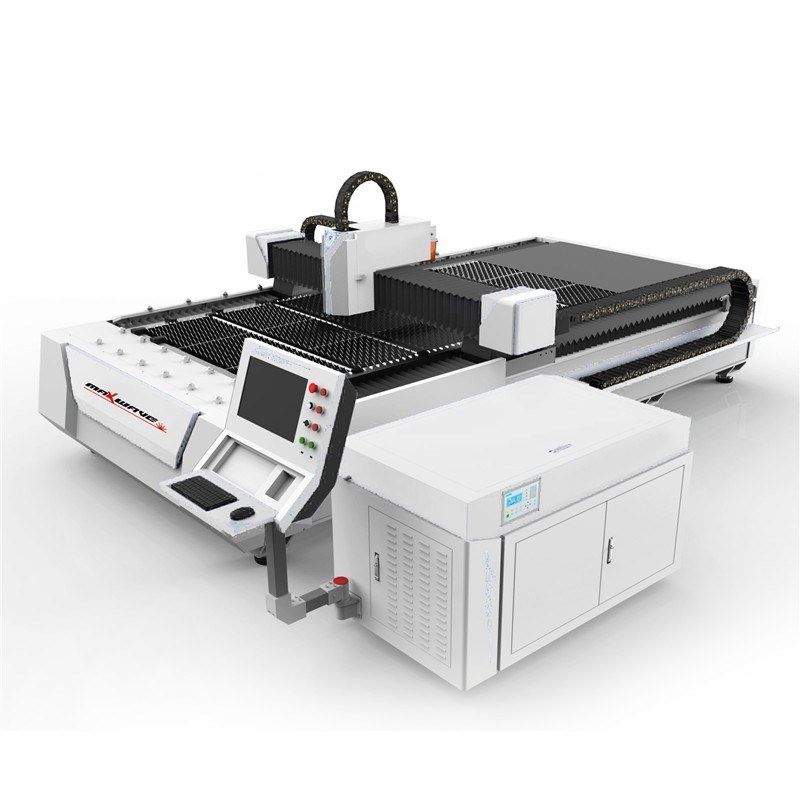
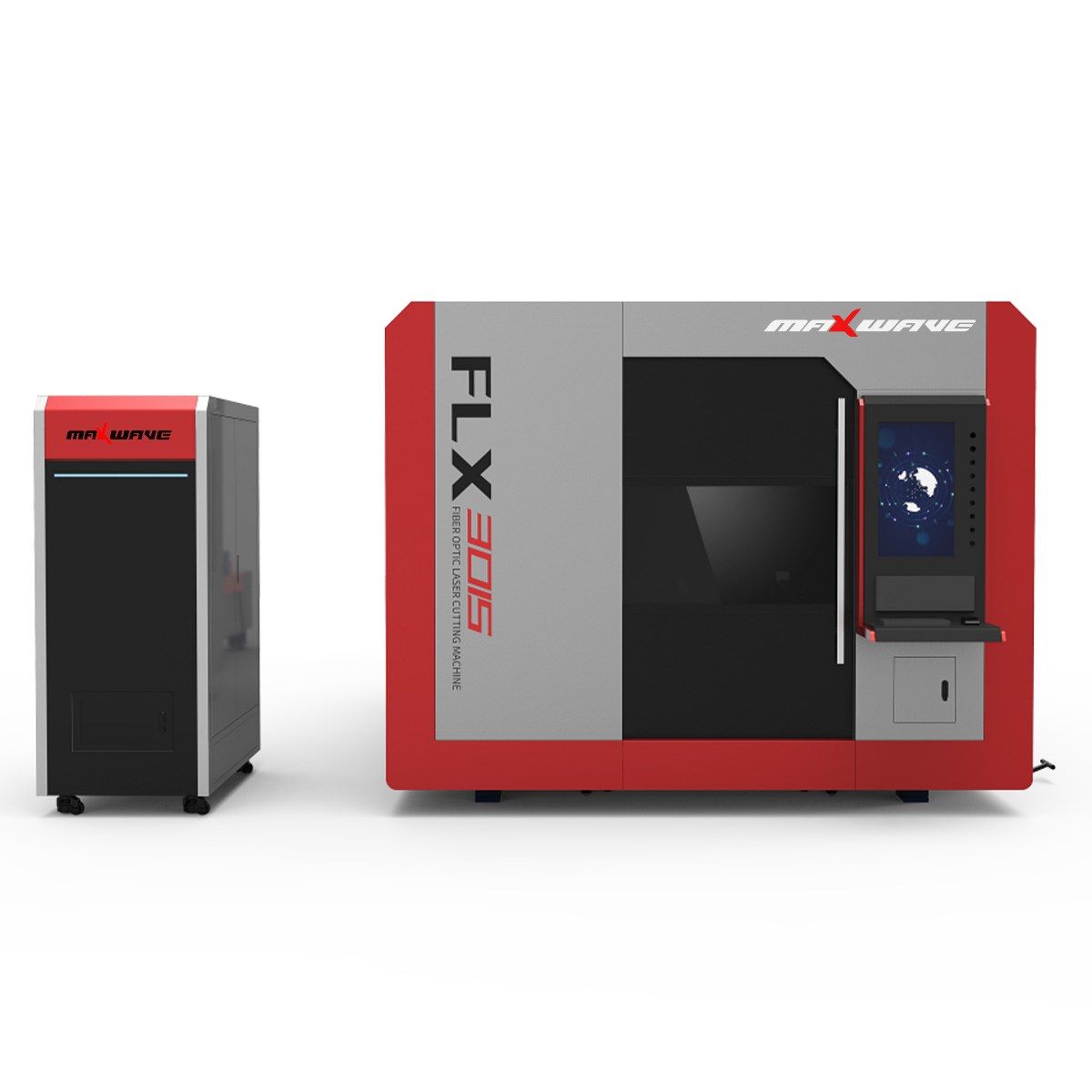
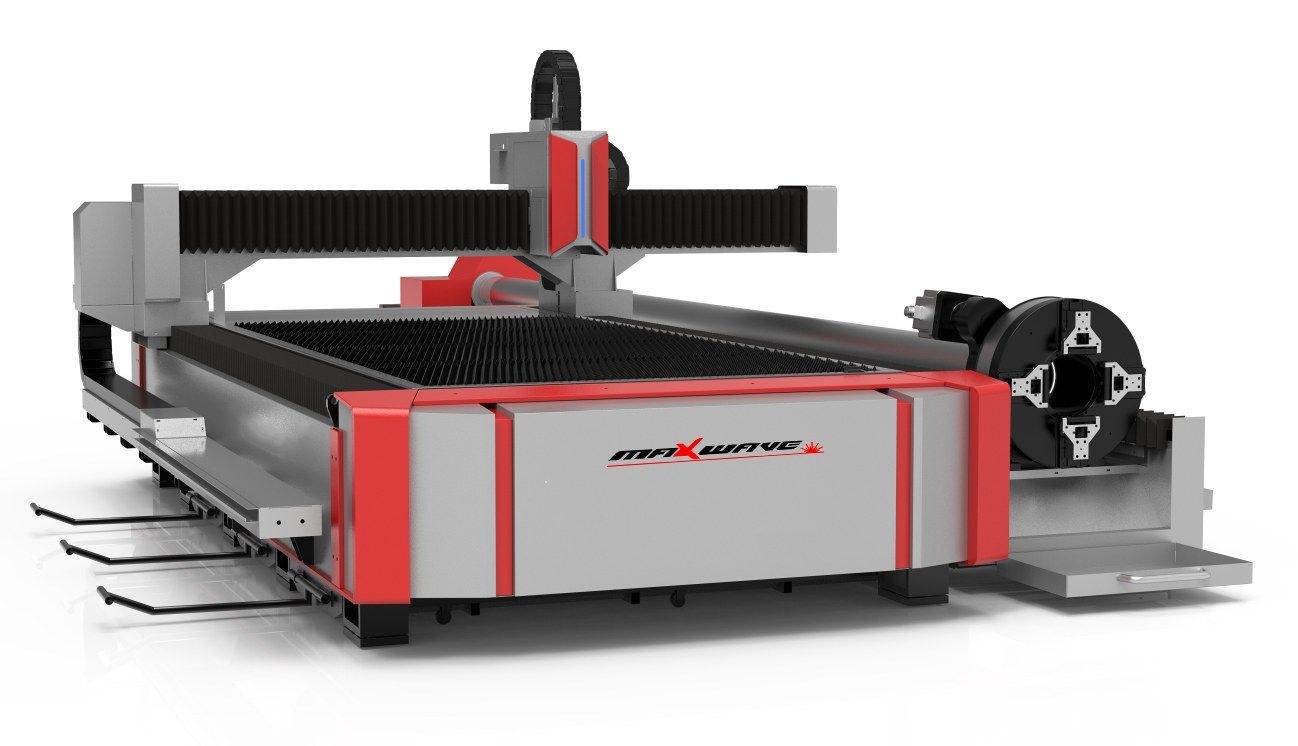
Sources from different makers behave slightly differently, and the cutting head and control system add their own offsets. When you order a cutter from Maxwave, the 1530 fiber laser cutting machine, the enclosed MW-FLX3015 at 3, 6 or 12 kW or the MW-FLSP sheet and tube cutter, ask for the cutting table that matches the laser source in your quotation, and send us your plate: we cut it in Wuhan on the configuration we quote and send the video and the settings (free sample testing).