Short answer
Choose the bed from your largest regular sheet and the tube from your thickest cut. A 1390 works on 1300 × 900 mm and a 1610 on 1600 × 1000 mm, and acrylic needs about 10 W of tube power per millimetre, so 60 W cuts about 6 mm and 150 W about 15 mm cleanly. In October 2026, US sellers listed 130–150 W glass-tube machines in these bed sizes at about $6,600–8,000, and RF metal-tube machines with a 1300 × 900 mm bed at $13,450–25,500.
Key takeaways
- The model number is the bed size in centimetres: a 1390 works on 1300 × 900 mm (1.17 m²) and a 1610 on 1600 × 1000 mm (1.60 m²), so the 1610 has about 37% more area.
- For acrylic, plan about 10 W of tube power per millimetre of thickness (Trotec's rule of thumb). One US maker lists 25.4 mm acrylic and 12.7 mm plywood as the maximum cut for its 150 W machine.
- Glass DC tubes give the most cutting power per dollar but wear out: Trotec puts their average life at about two years, against about six years for RF tubes, which also engrave finer raster detail.
- Size the chiller to the tube: TEYU pairs the CW-3000 with 40–80 W tubes, the CW-5000 with 60–120 W and the CW-5200 with 100–150 W, and recommends 18–22 °C cooling water.
- PVC and vinyl release hydrogen chloride gas, so process them only on a machine configured for PVC (corrosion-resistant parts and acid-gas fume treatment). Never leave a running laser cutter unattended, and duct the fumes outdoors or through a filter.
Size a CO2 laser engraving machine by its bed and its tube: choose the bed from the largest sheet you cut regularly (a 1390 works on 1300 × 900 mm, a 1610 on 1600 × 1000 mm), and the tube from your thickest cut, at about 10 W per millimetre of acrylic. In October 2026, US sellers listed 130–150 W glass-tube machines in these bed sizes at about $6,600–8,000, and RF metal-tube machines with a 1300 × 900 mm bed at $13,450–25,500.
Key numbers at a glance
| Decision | Typical numbers | Basis |
|---|---|---|
| Bed size | 1390 = 1300 × 900 mm (1.17 m²); 1610 = 1600 × 1000 mm (1.60 m²) | Industry model naming |
| Tube power for acrylic | About 10 W per mm of thickness | Trotec rule of thumb |
| Maximum cut at 150 W | Acrylic 25.4 mm, softwood 19 mm, plywood 12.7 mm | Full Spectrum Laser, 150 W glass tube |
| Chiller | CW-3000 to 80 W; CW-5000 60–120 W; CW-5200 100–150 W; water at 18–22 °C | TEYU selection guide |
| Listed price, 130–150 W glass, 1390/1610 class | $6,599.99–7,999.99 | OMTech, US, October 2026 |
| Listed price, 60–120 W RF, 1300 × 900 mm | $13,450–25,500 | Thunder Laser USA, October 2026 |
What do 1390 and 1610 mean, and which bed do I need?
The model number is the working area in centimetres: a 1390 works on 1300 × 900 mm and a 1610 on 1600 × 1000 mm. Other sizes use the same code, so a 6090 is 600 × 900 mm and a 1325 is 1300 × 2500 mm.
- Area. 1.6 m × 1.0 m = 1.60 m² against 1.3 m × 0.9 m = 1.17 m², so a 1610 has about 37% more bed.
- Full sheets. Neither bed takes a full 1220 × 2440 mm (4 × 8 ft) board. That needs a 1325-class bed, such as Full Spectrum Laser’s 1300 × 2500 mm Atlas.
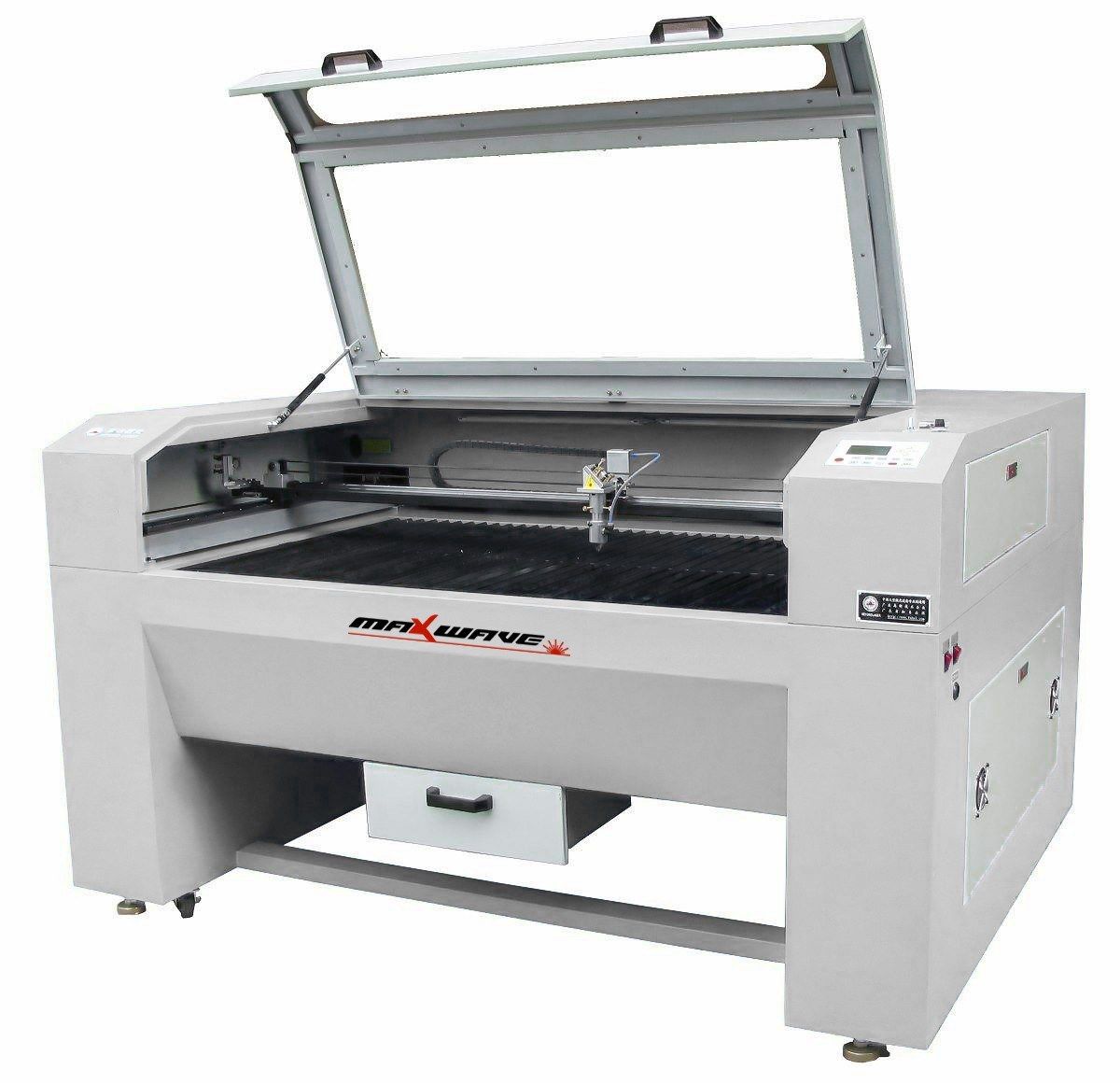
- Space. Maxwave’s 1390 weighs 225 kg gross. Leave room for the chiller, exhaust duct and loading.
- Tube length. Reci’s 90 W W2 tube is 1250 mm long and its 150 W W8 is 1850 mm. Ask whether the tube fits inside the cabinet.
Buy the bed for the largest sheet you cut every week. Cut oversize sheets down for the occasional big job.
How much tube power do I need: 40, 60, 80, 100, 130 or 150 W?
Choose the tube from the thickest material you must cut in one pass. For acrylic, Trotec’s rule of thumb is 10 W per millimetre, so 60 W cuts about 6 mm and 150 W about 15 mm with a clean edge. Engraving needs much less: Trotec lists 30–40 W for engraving MDF, acrylic and anodized aluminium, and extra watts mainly buy speed.
| Tube power | Acrylic, clean single pass | Plywood / MDF, single pass | Typical use |
|---|---|---|---|
| 40 W | 3–4 mm | Thin sheet only; test | Desktop engraving, thin acrylic |
| 60 W | About 6 mm | About 6 mm | Engraving, signs and crafts |
| 80 W | About 8 mm | About 7.5 mm* | Mixed engraving and cutting |
| 100 W | About 10 mm | About 9 mm* | Sign letters, 10 mm acrylic |
| 130 W | About 13 mm | About 11 mm* | Production cutting |
| 150 W | About 15 mm clean; 25.4 mm maximum | Up to 12.7 mm plywood; 19 mm softwood | Thick acrylic, high throughput |
How the numbers were made: acrylic thickness = tube power ÷ 10 (Trotec). Trotec lists 40 W for cutting 3 mm acrylic and 60 W as the minimum for 6 mm MDF. The 150 W maxima are Full Spectrum Laser’s figures. *Plywood and MDF for 80–130 W are a straight line between 6 mm at 60 W and 12.7 mm at 150 W: thickness ≈ 6 + (P − 60) × 0.074 mm. Boards vary, so test your own sheet.
Rated or maximum power? Reci’s datasheet gives two figures per tube: W2 90 W rated / 100 W maximum, W4 100/130 W, W6 130/160 W and W8 150/180 W. A tube sold as “130 W” may be a W4 rated at 100 W. Get the tube maker, model and rated power in writing. Near its maximum thickness a tube cuts slowly, so if thick acrylic is daily work, go one power step higher.
Glass DC tube or RF metal tube?
A glass DC tube gives the most cutting power per dollar and is replaced as a consumable. An RF metal or ceramic tube costs much more, lasts longer and engraves finer raster detail. Maxwave’s 1390 and 1610 use water-cooled glass tubes.
| Feature | Glass DC tube | RF metal or ceramic tube |
|---|---|---|
| Average life | About 2 years (Trotec) | About 6 years (Trotec) |
| Maker warranty example | Reci: 540 days (W1–W4), 360 days (W6, W8) | Synrad ti: power guaranteed for 2 years regardless of operating hours |
| Hour ratings in seller specs | “Up to 10,000 hours” (Full Spectrum Laser) | “Up to 10,000 hours” (Thunder Laser) |
| Beam quality claim | More than 95% TEM00 mode (Reci) | M² < 1.2 (Synrad ti) |
| Engraving | Good for wood, acrylic and most photo work | Much higher repetition rates, so each pixel can get its own pulse (Trotec) |
| Listed price, 1300 mm-wide bed | $7,199.99 for 130 W (OMTech) | $13,450 for 60 W to $25,500 for 120 W (Thunder Laser USA) |
The identical “10,000 hours” claims show that seller hour ratings say little. Compare warranty terms instead.
The 60 W RF machine costs 1.9 times as much as the 130 W glass machine ($13,450 ÷ $7,199.99) with less than half the power. For thick cuts, glass gives more for the money. RF can pay back for fine photo engraving, small text and two-shift production. On the same desktop chassis, OMTech’s Polar 2 lists at $3,699.99 with a 70 W glass tube and $4,999.99 with a 50 W RF tube.
How much does a CO2 laser engraving machine cost?
In October 2026, US sellers listed CO2 laser engravers from $599.99 for a 45 W desktop unit to about $8,000 for a 150 W glass-tube machine with a 1600 mm-wide bed. Prices below are listed US retail prices in USD, seen 8 October 2026, before sales tax, freight and import duty.
| Class | Bed | Listed example | Listed price |
|---|---|---|---|
| 45–55 W desktop, glass | 8 × 12 in (about 200 × 300 mm) on the K40+ | OMTech K40+ 45 W; Polar Lite 55 W | $599.99; $2,199.99 |
| 60–100 W mid-size, glass | 20 × 28 in (about 510 × 710 mm) | OMTech Maker and Pronto 35 series | $2,499.99–3,899.99 |
| 130 W, 1390 class, glass | 35 × 51 in (about 890 × 1295 mm) | OMTech Pronto 60 | $7,199.99 |
| 150 W, 1610 class, glass | 40 × 63 in (about 1015 × 1600 mm) | OMTech Maker AF4063-150; Pronto 75 | $6,599.99; $7,999.99 |
| 150 W, 1325 class, glass | 1300 × 2500 mm | Full Spectrum Laser Atlas | $19,995 |
| 60–120 W RF, 1390 class | 1300 × 900 mm | Thunder Laser Nova Plus 51 | $13,450–25,500 |
What drives the price: tube type and real rated power; bed size; servo motors, autofocus, motorized table and camera; what is included (chiller, exhaust, air compressor, rotary, software); warranty and local spare parts. Freight, duty and VAT vary by country, so compare quotes line by line. Our guide to buying laser machines from China covers import costs.
Running costs: a replacement glass tube about every two years (Trotec’s average); lenses and mirrors (Maxwave recommends keeping a spare lens, three spare mirrors and a spare tube); fume filters; electricity; and software renewals.
Which materials can a CO2 laser engrave and cut?
A CO2 laser engraves and cuts wood, acrylic, leather, fabric, paper and rubber. It engraves stone, glass and ceramic but cannot cut them. Our laser marking comparison explains why these materials absorb the 10.6 µm wavelength well.
- Wood. Solid wood, plywood, MDF and bamboo engrave and cut. Softwood cuts deeper than plywood: Full Spectrum Laser lists 19 mm against 12.7 mm at 150 W. Air assist reduces flame and charring on the edge.
- Acrylic (PMMA). Cuts with a polished edge and engraves well.
- Stone. Granite, marble, slate and tile engrave. Thunder Laser’s material chart lists marble, tile, glass and ceramic as engrave-only. A motorized table takes thick pieces.
- Leather, textiles, paper and rubber. Cut and engrave. Trotec lists 30 W for 2.3 mm rubber stamp material.
- Coated metal. Anodized aluminium and painted metal engrave, because the beam removes the coating.
What can a CO2 laser engraver not do?
A CO2 engraver cannot cut metal or mark bare metal without a coating, and a standard machine must not be used on PVC or vinyl.
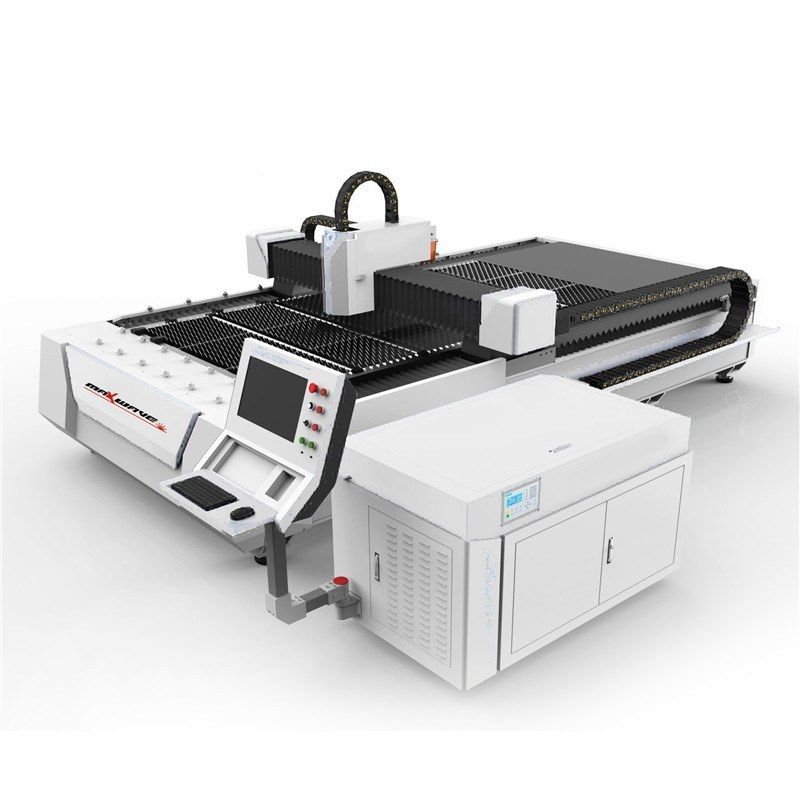
- Cut metal. A 40–150 W CO2 engraver cannot cut steel, stainless steel or aluminium sheet. Steel absorbs far less of the CO2 wavelength than of the 1064 nm fiber wavelength (see our marking comparison). Metal cutting with CO2 needs much higher power and an oxygen or nitrogen assist gas. For sheet metal, use a fiber laser cutting machine.
- Mark bare metal. It needs a coat of laser marking compound first. A fiber marker is the normal tool for bare metal.
- Cut PVC or vinyl on a standard machine. MIT’s safety office warns that PVC produces hydrogen chloride gas, “which is extremely dangerous”. With moisture it forms hydrochloric acid, which also attacks the optics and steel parts. Vinyl, PVC foam board and many imitation leathers are PVC. PVC work needs a machine configured for it: corrosion-resistant optics and parts, a closed enclosure, and fume extraction with acid-gas treatment. Say so when you order, and ask the supplier for the configuration in writing. If you do not know what a plastic is, do not cut it.
- Cut polycarbonate cleanly. Trotec says polycarbonate and SAN need 200–400 W for a clean cut, even at 2–3 mm.
Which chiller does a CO2 laser tube need?
Match the chiller to the tube power. TEYU’s selection table pairs the CW-3000 with 40–80 W tubes, the CW-5000 with 60–120 W, the CW-5200 with 100–150 W and the CW-6000 with 200–300 W. TEYU recommends 18–22 °C water and warns that water above 25 °C may speed up tube ageing.
- CW-3000. It has no refrigeration, so the water cannot get colder than the room. In a 30 °C workshop it cannot hold 18–22 °C.
- CW-5000 and CW-5200. Refrigerated units. TEYU’s text is stricter than its table: CW-5000 for 80–120 W and CW-5200 for 100–130 W, with some users running 150 W tubes on it. Full Spectrum Laser ships its 150 W Atlas with a CW-5200.
- Rule. For 130–150 W tubes on long cuts, or in a hot room, choose the larger unit.
Maxwave’s 1390 and 1610 are water-cooled with a protection system, and the standard kit lists a water pump. Confirm in your quote which chiller is included and that it suits your tube and room temperature.
What ventilation and fire safety does a CO2 laser need?
Duct the fumes outdoors, never leave a running laser cutter unattended, and mount a fire extinguisher near the machine. MIT’s safety office says laser cutters “require special ventilation”.
- Extraction. For scale, Thunder Laser fits a 735 CFM (about 1,250 m³/h) exhaust fan on an 8-inch (about 200 mm) port to its 1300 mm-wide Nova Plus 51. Full Spectrum Laser lists a 750 W (1 HP) exhaust fan for its 1300 × 2500 mm Atlas. Keep the duct short, with few bends.
- Filters. If you cannot duct outdoors, use a filter unit with particle and activated-carbon stages.
- Fire. Watch every job. MIT calls a working air assist important, and regular vacuuming of the cutting deck and the inside of the machine very important, for preventing fires. Keep solvents and scrap away from the machine.
- Interlocks. Keep them working, and let the exhaust clear the cabinet before you open the lid.
Ruida, RDWorks or LightBurn: which controller and software?
Many 1390 and 1610 machines, including Maxwave’s, use a Ruida DSP controller that stores jobs and runs them offline from its own panel. Ruida’s software is RDWorks. LightBurn is a paid third-party program that some sellers bundle: Thunder Laser includes it for two computers with its Nova Plus machines.
Maxwave’s controller runs jobs from a USB flash drive or directly from a computer. It comes with LaserCut 5.3, which imports PLT, DXF, AI, BMP and DST files and works with CorelDRAW and AutoCAD. Before you buy, check that your design files open and which software licence the quote includes.
Galvo CO2 or gantry CO2?
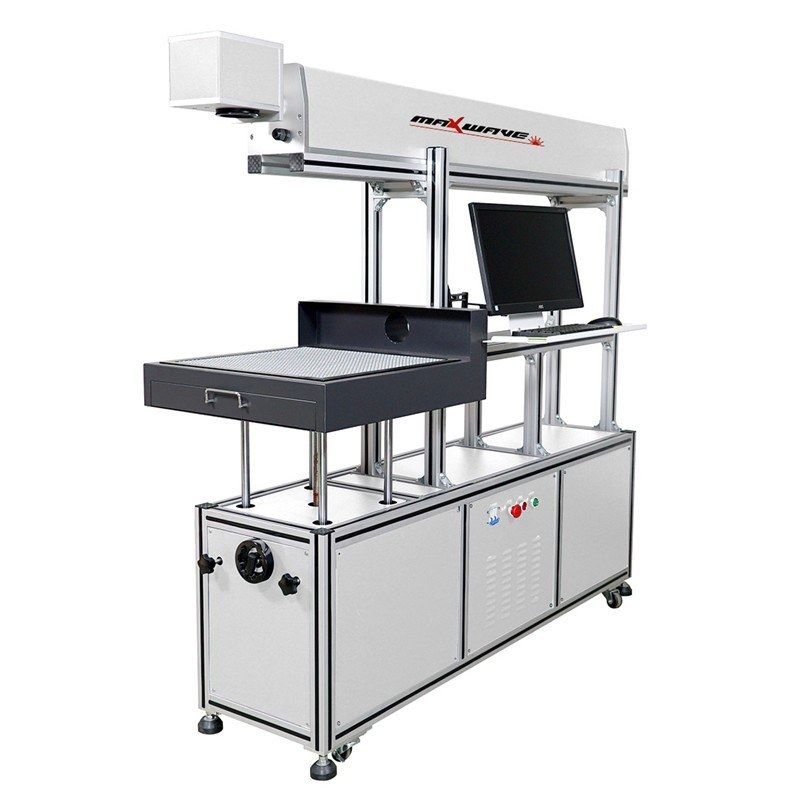
Use a gantry (flatbed) machine to cut sheets and engrave large areas. Use a galvo CO2 marker for fast marking inside a fixed field.
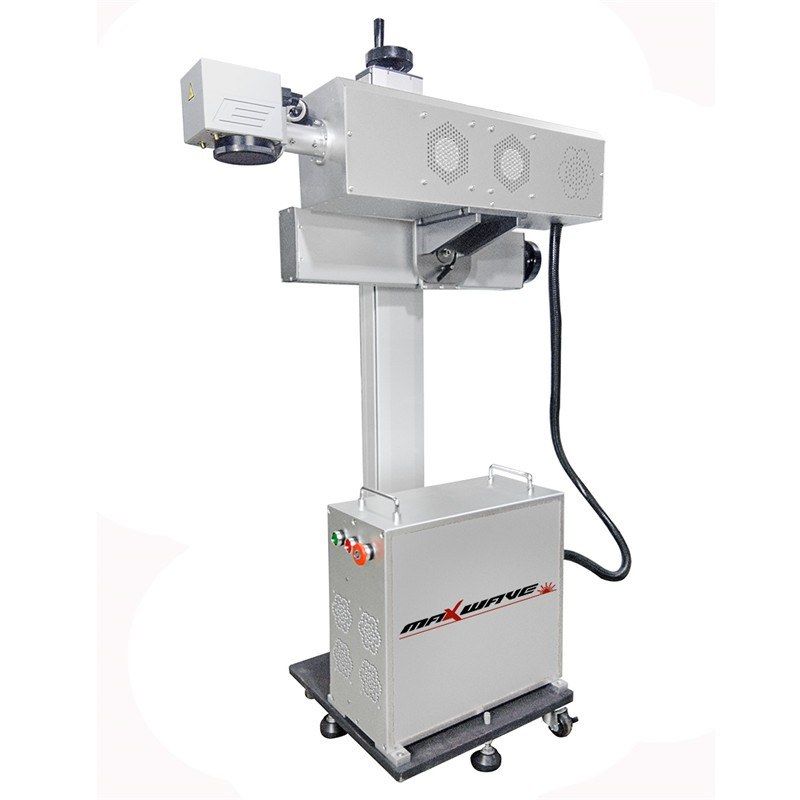
- Galvo. Two mirrors steer the beam through an f-theta lens, so text, logos, codes and denim patterns mark much faster than with a moving head. A larger field gives a larger spot. Galvos cut only thin material. Flying versions code moving products on a conveyor.
- Gantry. The head travels over the whole bed. It cuts thick sheets and large parts, but raster engraving of large areas is slower.
The fiber vs UV vs CO2 marking guide covers galvo field sizes, and laser marking machines lists Maxwave’s 30–150 W CO2 markers.
How to decide: a buyer’s checklist
- List your materials and the thickest one you must cut in one pass.
- Set tube power at acrylic thickness in mm × 10 W. Go one step higher if thick cuts are daily work.
- Set the bed from your largest weekly sheet: 1390, 1610, or 1325 for full 4 × 8 ft boards.
- Choose glass for cutting power per dollar, or RF for fine engraving and long duty cycles.
- Get the tube maker, model, rated and maximum power, and tube warranty in writing.
- Size the chiller to the tube and your hottest room temperature.
- Plan the exhaust route, fan and fire extinguisher before delivery.
- Confirm the controller, software, file formats and spares (lens, mirrors, tube).
- Compare quotes line by line, including freight, duty and VAT, and test-cut your own material first.
Maxwave’s 1390 and 1610 CO2 engraving and cutting machines (60–150 W) are listed under laser engraving and cutting machines. The site shows only part of the range, and other configurations are available on request. To check cutting speed and edge quality on your own material, use sample testing.
Sources
- Reci Laser: CO2 laser tube W series (rated and maximum power, length, warranty)
- Novanta Photonics (Synrad): ti Series 60–100 W RF CO2 lasers, specifications
- Trotec Laser: DC and RF laser tubes (laser wiki)
- Trotec Laser: What is the optimal laser power? (FAQ)
- Full Spectrum Laser: Atlas 4' x 8' 150 W flatbed CO2 laser system (specifications, maximum cutting thickness, price)
- TEYU: Which CO2 laser chiller is right for your laser tube? A practical selection guide (May 2026)
- MIT Environment, Health & Safety: Laser cutter safety
- OMTech: CO2 laser machines, listed prices (seen October 2026)
- Thunder Laser USA: Nova Plus 51 RF CO2 laser, specifications and listed prices (seen October 2026)