Short answer
Check the crate before you sign, fill a water-cooled machine with pure water, connect nitrogen or argon, and switch on in the manual’s order. That manual specifies single-phase 220 V ±10% for 800–2000 W, three-phase 380 V ±10% for 3000 W, and a suggested 32 A breaker. Confirm the nameplate. This page does not add warranty terms.
Key takeaways
- The WeldStar handheld welder manual (version 2024.05) specifies single-phase 220 V ±10% for 800–2000 W and three-phase 380 V ±10% for 3000 W, a cable of at least 6 mm², a suggested 32 A breaker and a ground of at most 4 Ω.
- Water-cooled machines take about 15 L of pure, distilled or ultrapure water, filled to the green range. The air-cooled version in that manual does not take this fill.
- The same manual recommends nitrogen or argon, allows compressed air when the surface finish is less critical, and says the flow meter is not less than 15 L/min and the pressure gauge is not less than 3 bar. Set the regulator before you open the cylinder valve. The specification table’s maximum is 15 bar.
- Power on in the manual’s order, and power a water-cooled machine off by pressing the white button before the main switch. Check the protective lens for burn spots before you weld.

The steps below are taken from the Handheld Laser Welder User Manual, version 2024.05, Wuhan Maxwave Laser Technology Co., Ltd. (the WeldStar air-cooled Breeze and water-cooled Aqua manual), from a generic air-cooled unpacking section in a different maker’s manual, and from a generic English first-startup procedure. Each step says which document it comes from. The manual is not offered as a download.
If the crate or the machine is damaged, or it does not work, follow what happens if a laser machine arrives damaged or doesn’t work. This page does not restate those terms and does not add any.
How do I unbox and power on a handheld laser welder?
Check the crate before you sign, fill a water-cooled machine with pure water, connect nitrogen or argon, and switch on in the manual’s order. That manual specifies single-phase 220 V ±10% for 800–2000 W, three-phase 380 V ±10% for 3000 W, and a suggested 32 A breaker. Confirm the nameplate. This page does not add warranty terms.
How it is packed
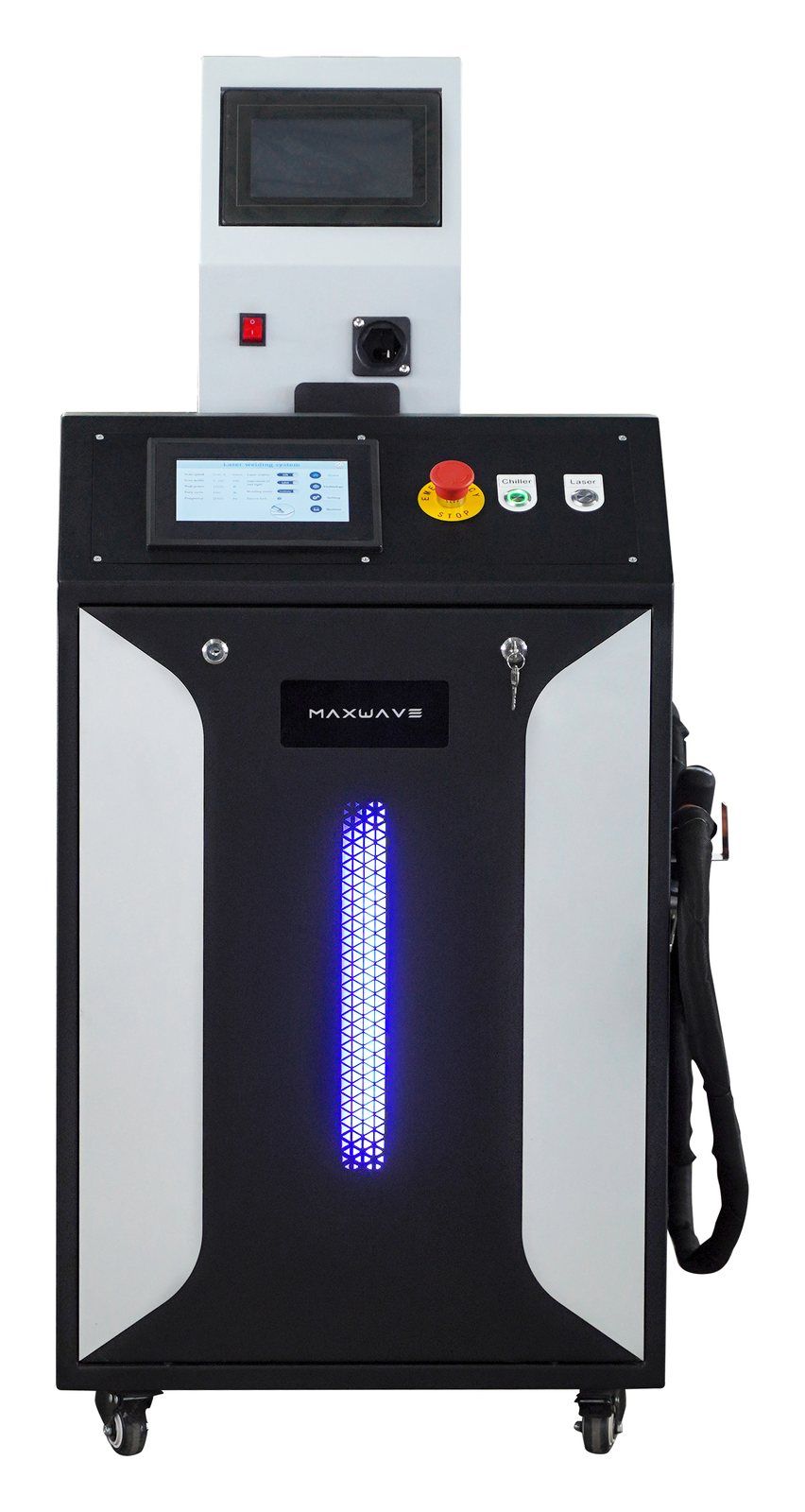
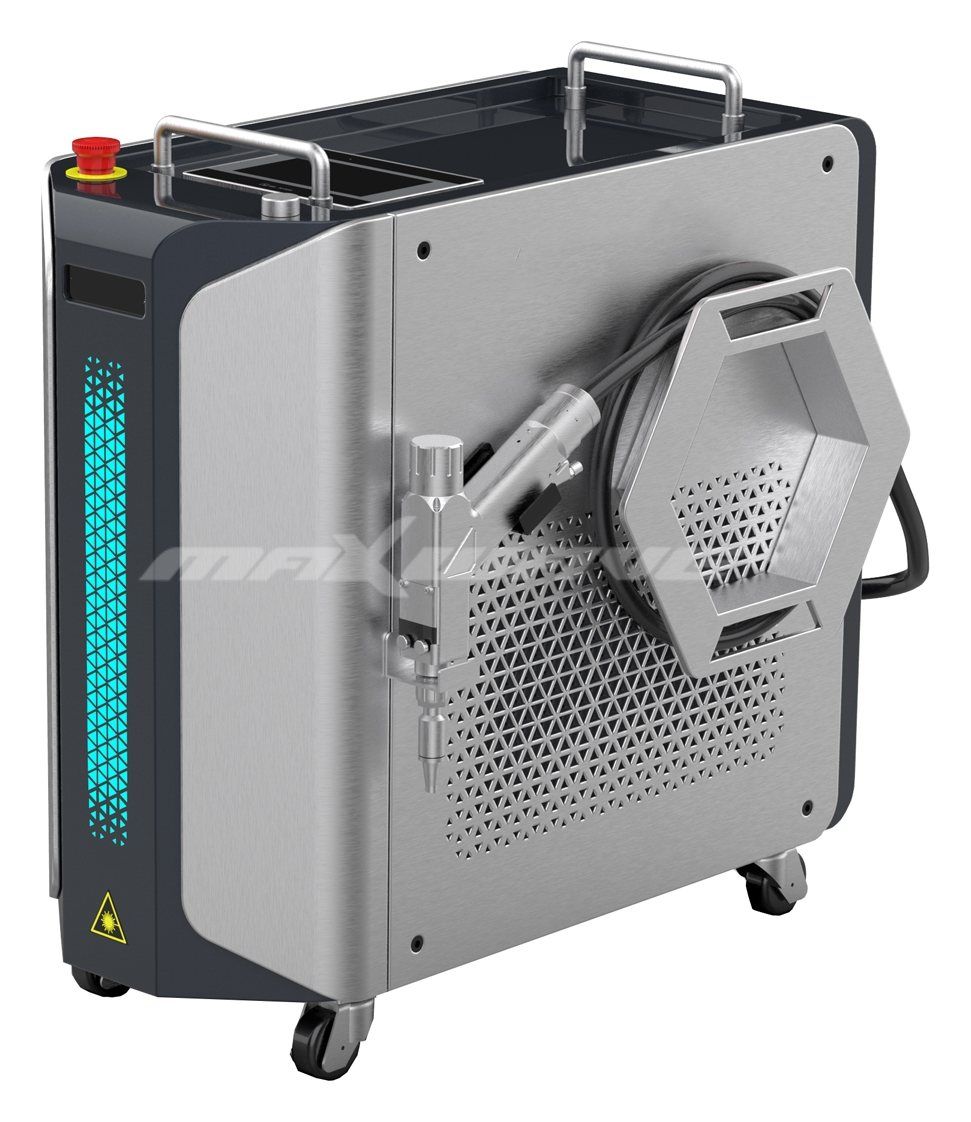
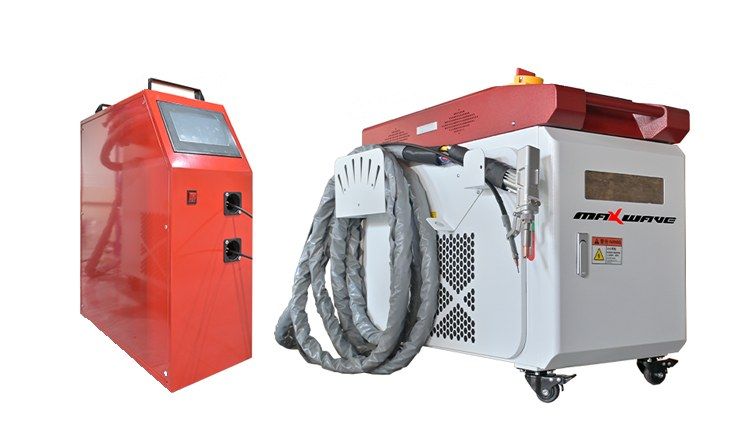
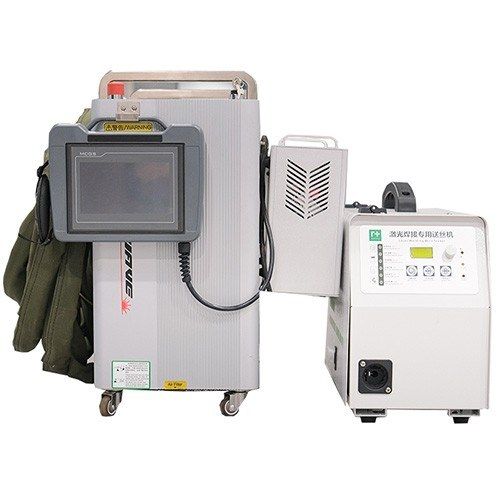
The photograph on this page shows a handheld laser welder on its trolley, shrink-wrapped on a wooden pallet inside the factory. It does not show a crate, a truck or a delivery. More photographs of crates and loading are on the service and warranty page. They do not state a transit time.
Check the crate before you open it
An air-cooled handheld welding-system manual, Reci FCA-series V1.1 (Beijing Reci Laser, 15 February 2022), is not a Maxwave manual. Its unpacking section, used here only as generic receiving steps, says to check before opening that the crate is the right way up and that the outside shows no collision damage, cracks, rain or water immersion, and after opening to check the contents against the packing list. When the machine is lifted out, avoid impact or strong vibration, and do not twist, kink or pull the coiled output fibre. If the crate is damaged, tell the supplier. On this site that report is the arrival section.
Water, gas and the electrical supply
From the WeldStar manual, version 2024.05.
Water. Prepare about 15 L of pure, distilled or ultrapure water for a water-cooled machine. Pour it into the fill port until the level is in the green range, then tighten the dust cover. The air-cooled Breeze version in that manual does not take this fill. Later maintenance in the same manual says to top up with deionized or pure water, replace the water every 60 days, check the filter every 3 months, and drain the chiller if the machine will sit unused. The manual does not give an antifreeze mixture.
Gas. The manual recommends nitrogen or argon, and allows compressed air when the surface requirement is not high. Connect the 8 mm gas pipe fully. It says the flow meter is not less than 15 L/min and the pressure gauge is not less than 3 bar. Set the regulator to the required pressure before you open the cylinder valve, because opening the valve first can burst the hose. The specification table lists a maximum gas pressure of 15 bar. That maximum is not the welding setpoint. A factory selection sheet, already published on the running-cost guide, gives 0.15–0.3 MPa of nitrogen or argon for welding. Which gas to use, and how the head manuals differ, is in does a laser welder need gas.
On a water-cooled machine the manual also says to fit the gas-cylinder bracket to the cart, lock the wheels, and have two people handle the cylinder. It says that bracket step is not required on the mobile air-cooled machine.
The Reci FCA-series V1.1 manual, again not a Maxwave manual, states an input gas pressure not greater than 0.7 MPa for that air-cooled system. That figure is that document’s maximum. It is not the WeldStar welding setpoint.
Supply. For 800–2000 W the manual says single-phase 220 V ±10%. For 3000 W it says three-phase 380 V ±10%. The cable cross-section is at least 6 mm². It recommends a 32 A breaker, a ground resistance of at most 4 Ω, and not sharing that breaker with other high-power equipment. Confirm the nameplate of the machine in the quotation before an electrician connects it. The manual’s wiring colours are in the installation section of that document; have a qualified electrician make the connection.
First power-on order
From the WeldStar manual, under “Device Power On and Off Procedures”.
Air-cooled, WeldStar-Breeze. After the supply is connected, turn the red knob switch to ON, press the laser button, open the gas-cylinder valve, and connect the safety ground clamp to the workpiece, or to the table or fixture that is connected to the workpiece. Power off in the reverse order.
Water-cooled, WeldStar-Aqua. Push the main power switch at the back up to ON, press the green button, open the gas-cylinder valve, and connect the safety ground clamp the same way. When powering off, press the white button first to shut down the laser and the water cooler, then turn off the main power.
The manual says a temperature alarm can appear in low or high ambient temperature. Wait until the temperature reaches the set alarm value and the laser alarm clears before you continue. It also says the safety loop shows green when the metal clip is on the workpiece and the copper nozzle touches the workpiece.
The same manual’s lens section says to check the protective lens and to replace it immediately if burn spots are visible, and to replace the white seal under the lens if it is scratched or deformed. Do that check before the first weld, with clean hands, in a place that is as free of dust as you can make it.
A separate first-startup sheet
An English “First Startup Procedure”, with no client name, was reviewed for a water-cooled machine that has an external water tank, a dust collector and a keyed control panel. It is not the WeldStar order above, and it is not published as a download. Written here as generic steps, it says:
- Fill the external tank to about two-thirds of the green area on the level indicator.
- Connect the water pipes, and check the internal water connections before power is applied.
- Connect the air supply and the argon or nitrogen supply.
- Connect the tank’s power lead, then the main cable to a 220 V, 50 Hz supply.
- Close the breaker, start the tank while watching for leaks, then start the dust collector.
- Turn the key, start the computer, then press the drive and laser buttons, and open the programming software.
Use the WeldStar order for a Maxwave handheld welder of the Breeze or Aqua type. Use this sheet only as the shape of a first-startup list for a machine that matches it. Ask which list applies to the machine in your quotation.
Settings by thickness are in the handheld laser welding parameters guide. What the machine draws, and the gas and lens lines you price yourself, are in the handheld laser welder running cost guide.
Short clips of the handheld welders, the 4-in-1 and the cleaning machines already embedded on product pages are collected on the machine videos page, with two short clips of a KRD cleaning head. Maxwave does not manufacture that head.