Short answer
Yes. A 1000–2000 W handheld fiber laser welds 1xxx, 3xxx, 5xxx and most 6xxx aluminium, typically 1–4 mm in everyday work and up to about 6–8 mm on 5xxx alloys at 2000 W. Clean, oxide-free joints, dry argon and the right filler wire (4043 for crack resistance, 5356 for strength) matter more than extra watts. Avoid 2024, 7075 and most other 2xxx and 7xxx alloys.
Key takeaways
- At 2000 W, Lincoln and Miller presets weld aluminium from 1 mm up to 4–6.4 mm, and IPG quotes up to 5.8 mm on 6xxx and 8.3 mm on 3xxx and 5xxx alloys.
- Aluminium is highly reflective to a fiber laser beam until a keyhole forms. Once it does, absorption rises to 72–93% in tests with a 10 kW fiber laser (Kawahito et al.), so start-up power density and focus matter more than on steel.
- Use 100% argon. Lincoln and Miller specify argon for aluminium even though their steel presets use nitrogen, which can form nitrides in aluminium welds.
- Choose 4043 wire for the lowest crack risk and for service above 65 °C. Choose 5356 for shear strength, anodized colour match and any 5xxx alloy with more than 2.5% magnesium (Hobart).
- Hydrogen causes most aluminium porosity. Molten aluminium holds about 20 times more hydrogen than solid aluminium, so oil, moisture and hydrated oxide must be removed before welding.
Yes. A handheld fiber laser welds aluminium (aluminum) well if the alloy is a weldable grade and the joint is clean. At 1000–2000 W, maker presets cover about 1–4 mm in everyday work, and the highest published figures reach about 6–8 mm on 5xxx alloys at 2000 W. Most failed aluminium welds trace back to oxide, hydrogen or a crack-sensitive alloy. Power is rarely the limit on sheet.
How thick can a handheld laser weld aluminium?
A 1000 W handheld welds about 1–2 mm of aluminium in daily work, a 1500 W unit about 2–4 mm, and a 2000 W unit about 2–5 mm, with wire on the thicker joints. The table combines published data from IPG, Lincoln Electric and Miller. The preset figures come from Lincoln’s and Miller’s 2 kW machines at the power shown, and are settings a new operator can repeat. IPG’s figures are maximums under good conditions.
Single-side aluminium weld thickness for handheld fiber lasers (published maker data)
| Laser power | Maker presets (repeatable starting settings) | IPG upper figure, 3xxx/5xxx | IPG upper figure, 6xxx |
|---|---|---|---|
| 1000 W | 1–2 mm. Miller runs 3.2 mm 6xxx at 900 W | 3.3 mm | 3.3 mm |
| 1500 W | 2–4 mm. Lincoln runs 3–4 mm with wire at 1,400–1,500 W | 5.8 mm | 5.2 mm |
| 2000 W | Lincoln: 2 mm without wire, 4 mm with wire. Miller: 4.8 mm on 6xxx, 6.4 mm on 5xxx | 8.3 mm | 5.8 mm |
| 3000 W | No published handheld aluminium presets from these makers | No figure | No figure |
IPG gives its figures in inches: 0.129 in. at 1000 W, 0.229 and 0.204 in. at 1500 W, and 0.325 and 0.229 in. at 2000 W. IPG rates 6xxx alloys lower than 3xxx and 5xxx at 1500 W and above. Buy on the preset column and treat the upper figures as headroom. At 3000 W, expect more travel speed and margin on 4–6 mm work, and prove the thickness on test coupons first. Our handheld laser welder power guide compares the same power classes on steel.
Why is aluminium harder to laser weld than steel?
Aluminium is highly reflective to a 1070 nm fiber laser beam until a keyhole forms, and it conducts heat away fast. Researchers at Osaka University sum it up: laser welding of aluminium alloys is difficult because of their high reflectivity and heat conductivity. Once the keyhole is open, the weld traps the beam. In their tests on 5052 alloy with a 10 kW fiber laser, the weld absorbed 93% of the beam at 17 mm/s and 72% at 250 mm/s.
What this means on a handheld welder:
- Start-up is the hard part. The beam must reach keyhole power density on a reflective surface. Lincoln shortens the focal tube to the −2 position for aluminium (−4 with wire) against 0 for stainless steel, and states that a shorter focal tube increases the energy absorbed. Miller lists a separate nozzle extension for aluminium.
- Thin aluminium can need more power than thin steel. Lincoln’s presets use 800 W for 1 mm aluminium and 500 W for 1 mm stainless steel.
- Reflections are a hazard. Before the keyhole forms, much of the beam bounces off the part. Plan the laser controlled area with our handheld laser safety guide.
What settings do makers use for laser welding aluminium?
Start from your machine maker’s aluminium presets, then adjust on test coupons. Lincoln and Miller both publish 2 kW handheld presets for aluminium, and at 1 mm they differ by more than two times. Each maker’s numbers fit its own optics, wobble pattern and travel speed, so settings do not transfer between machines.
Published 2 kW handheld presets for aluminium (laser power, W)
| Thickness | Lincoln, no wire | Lincoln, with wire | Miller 6xxx, no wire | Miller 6xxx, 1.2 mm 5356 wire |
|---|---|---|---|---|
| 1 mm | 800 | 800 | 300 | 500 |
| 2 mm | 1,200 | 1,100 | 600 | 900 |
| 3–3.2 mm | – | 1,400 | 900 | 1,700 |
| 4–4.8 mm | – | 1,500 | 1,400 | 2,000 |
Lincoln lists power as a percentage of 2,000 W, converted here to watts, at 1, 2, 3 and 4 mm. Miller’s columns are 18 gauge (1.0 mm), 12 gauge (2.0 mm), 1/8 in. (3.2 mm) and 3/16 in. (4.8 mm).
Other settings from the same documents:
- Gas: 100% argon from both makers. Lincoln specifies 32–75 CFH (about 15–35 L/min) with 0.5 s pre-flow and post-flow.
- Wobble: Lincoln uses 60 Hz, with 2 mm width without wire and 3 mm with wire.
- Ramps: Lincoln sets 100 ms up-slope and 100 ms down-slope.
- Wire feed: Lincoln sets wire feed equal to travel speed, at 10 mm/s (0.6 m/min), or 6 mm/s at 4 mm. Miller feeds 20 in./min (about 8.5 mm/s) up to 1/8 in.
- Wire hardware: Miller uses 1.2 mm and 1.6 mm 5356 wire with aluminium-specific liners, conduit and U-groove drive rolls. Lincoln’s presets were developed with 1.14–1.57 mm wire.
Which aluminium alloys can you laser weld?
The 1xxx, 3xxx and 5xxx series weld well, 6xxx alloys weld with care and filler wire, and most 2xxx and 7xxx alloys should not be fusion welded. Chemistry sets the crack risk. Hobart’s cracking curves show that small additions of silicon, copper, magnesium or magnesium silicide raise crack sensitivity to a peak, after which it falls again. TWI names the heat-treatable 2xxx, 6xxx and 7xxx series as prone to solidification cracking in laser welding.
| Series (examples) | Main alloying | Laser weldability | Usual filler |
|---|---|---|---|
| 1xxx (1050, 1100) | None (99%+ Al) | Good | 4043 |
| 3xxx (3003) | Manganese | Good | 4043 |
| 5xxx up to 2.5% Mg (5052) | Magnesium | Good with wire. 5052 sits near the crack peak, so do not weld it without filler | 4043 or 5356 |
| 5xxx over 2.5% Mg (5083, 5086) | Magnesium | Good. Low crack sensitivity | 5356. Do not use 4043 |
| 6xxx (6061, 6063, 6082) | Magnesium and silicon | Fair. Crack-sensitive, and the heat-affected zone loses 30–50% of its strength | 4043 or 5356 |
| 2xxx (2017, 2024) | Copper and magnesium | Poor. 2219 is an exception | Avoid fusion welding |
| 7xxx (7050, 7075) | Zinc, magnesium, copper | Poor. Copper-free 7005 is an exception | Avoid fusion welding |
| Die castings (AlSi9Cu3) | Silicon and copper | Variable. Trapped gas causes porosity and blowouts | Test first |
Hobart classes 2024, 7075 and 7050 as non-weldable by arc processes. Low-melting elements collect at grain boundaries in the heat-affected zone, crack under shrinkage stress, and leave the joint prone to stress corrosion cracking. These alloys are normally riveted, bolted or friction stir welded. On 6xxx parts, design for the as-welded strength of the joint, because welding anneals part of the heat-affected zone.
Should you use 4043 or 5356 filler wire?
Use 4043 when crack resistance matters most, and 5356 when you need strength, ductility or an anodized colour match. Hobart reports that 4043 (with its stronger variant 4943) and 5356 are used in over 85% of aluminium weldments. Its selection rules:
- 6xxx and 5xxx with up to 2.5% Mg: either wire works.
- 5xxx with more than 2.5% Mg (5083, 5086): 5356 only. 4043 forms excess magnesium silicide in these welds.
- Anodized parts: 5356. Welds made with 4043 turn dark grey when anodized.
- Sustained service above 65 °C (150 °F): 4043 or 5554. Do not use 5356.
- Fillet shear strength: 5356. Hobart’s rule of thumb is that three fillet passes of 4043 equal the shear strength of one pass of 5356.
- Less crater cracking and distortion: 4043.
- Wire feeding: 5356 is about twice as stiff as 4043, so it feeds more easily through a long handheld cable.
Wire matters even more with a laser. Without wire, a laser weld is 100% base metal and carries the base alloy’s crack sensitivity. With wire, the weld chemistry is roughly a weighted average of filler and base metal:
Weld Mg ≈ (filler share × filler Mg) + (base share × base Mg)
Hobart’s example uses 6061 (1% Mg) and 5356 wire (5% Mg). At 20% filler, the weld holds 0.2 × 5 + 0.8 × 1 = 1.8% Mg, which is crack-sensitive. At 60% filler, it holds 0.6 × 5 + 0.4 × 1 = 3.4% Mg, which is not. If 6xxx welds crack, add more wire. Raise wire feed against travel speed, or prepare a bevel or gap for the wire to fill.
Argon or nitrogen for laser welding aluminium?
Use 100% argon. Lincoln’s and Miller’s handheld presets both specify argon for aluminium, while both use nitrogen for steel and stainless steel. A Messer Griesheim patent on gases for laser welding aluminium names argon, helium and their mixtures as the usual protective gases. It notes that attempts to weld with pure nitrogen have run into nitride formation, and it caps its own nitrogen addition at 80–250 parts per million because more impairs the weld appearance.
Gas quality matters as much as gas type. Hobart specifies argon of at least 99.997% purity with a dew point of −60 °C (−76 °F) or lower. Moisture in the gas becomes hydrogen in the weld.
Helium does not help every job. In TWI’s laser trials on 6061 and 2024, welds shielded with helium showed longer centreline cracks than welds shielded with argon.
What causes porosity in laser-welded aluminium?
Hydrogen causes most porosity, and an unstable keyhole causes much of the rest. Hobart’s solubility chart gives about 0.7 mL of hydrogen per 100 g in liquid aluminium against 0.036 mL in the solid, a drop of about 20 times. Hydrogen picked up by the pool comes out as bubbles when the weld freezes. In laser welding, the keyhole can also pinch off and leave vapour pockets that cannot escape before the metal solidifies (Kamm et al.).
Hydrogen sources and fixes, from Hobart’s guide:
- Oil, grease, lubricants and marker: solvent clean every joint with a clean cloth.
- Hydrated oxide: aluminium oxide absorbs moisture. Store metal dry and brush the joint before welding.
- Condensation: bring metal and wire into the welding area 24 hours before welding.
- Gas system: check for leaks in gas lines and water-cooled torches.
- Compressed air: never blow joints clean with shop air, which carries oil and water.
For keyhole porosity, keep travel speed and focus steady. Die castings need extra care. Kamm et al. show that pressurised gas cavities inside a die casting can burst into the pool and cause high porosity and blowouts, so test castings before you quote them.
What causes hot cracking, and how do you prevent it?
Hot cracks form when the last liquid in the weld freezes under shrinkage stress, usually along the centreline or in the end crater. Chemistry sets the risk, and speed and restraint decide whether a crack appears.
- Add filler on 6xxx and lean 5xxx alloys. 4043 gives the lowest crack risk.
- Keep travel speed up. In TWI’s trials at constant power, slower welds produced longer centreline cracks.
- Reduce restraint. TWI found that clamping and part shape affected where cracks started and how far they ran.
- Fill the crater. Use the down-slope or crater-fill setting and avoid concave beads.
- Test wobble before relying on it. In a study on 1 mm 6014 sheet, most wobble settings widened the weld centre and raised crack susceptibility compared with straight welding. Only a figure-eight pattern at 100 Hz broke up the crack-prone zone.
How should you prepare aluminium before laser welding?
Degrease first, then stainless-brush, then weld promptly. Hobart warns that brushing before solvent cleaning presses hydrocarbons into the surface, and that fusion will not occur across an oxide barrier.
- Use a non-chlorinated solvent and a clean cloth, then a stainless steel brush kept only for aluminium.
- File band-sawn edges, which smear metal over the joint face.
- Remove at least 3 mm (1/8 in.) from plasma- or laser-cut edges of 2xxx, 6xxx and 7xxx alloys. Hobart notes that these melted edges contain solidification cracks.
- Clamp for tight fit-up. Gap rules are the same as for steel, and our power guide gives TWI’s limits with and without wobble and wire.
Laser cleaning is a clean alternative to brushing on production runs. Some handheld welders include a cleaning mode, and Miller’s OptX 2 kW has three aluminium cleaning programs at 1,200–1,400 W. Our guide to pulsed vs continuous laser cleaning explains which type suits weld preparation on aluminium.
When is TIG or MIG still better for aluminium?
Choose TIG or MIG for thick plate, poor fit-up and jobs that need a lot of filler metal. In detail:
- Plate over about 6 mm. The highest handheld figures stop at 5.8–8.3 mm at 2000 W. Multi-pass MIG handles thicker sections.
- Wide or uneven gaps. Arc processes add filler faster and bridge gaps more easily.
- Crack-prone 6xxx joints that need high filler share. A bevelled arc weld reaches Hobart’s 60% filler example easily.
- Outdoor and site work, where a laser controlled area is hard to set up.
Our guide to laser welding vs TIG and MIG compares the processes in detail.
How to decide
- Identify the alloy and temper of every part. Stop at 2xxx, 7xxx and die castings until you have test results.
- Pick power from the preset column for the thickness you weld every week. For 2–4 mm work, 1500–2000 W with a wire feeder covers most jobs.
- Choose wire: 5356 for 5xxx, anodized parts and fillets; 4043 for crack-prone joints and hot service.
- Budget for dry argon of 99.997% purity and an aluminium wire kit with U-groove drive rolls and the matching liner.
- Write a cleaning routine: solvent, stainless brush or laser cleaning, then weld promptly.
- Qualify the procedure with macro sections and bend or break tests. For structural work, follow AWS D1.2.
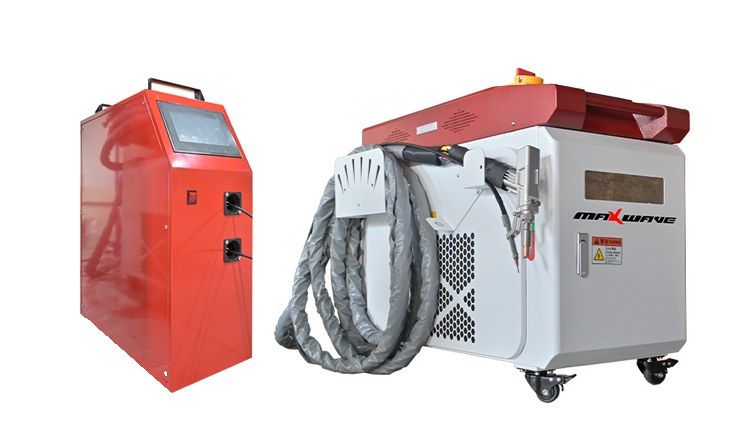
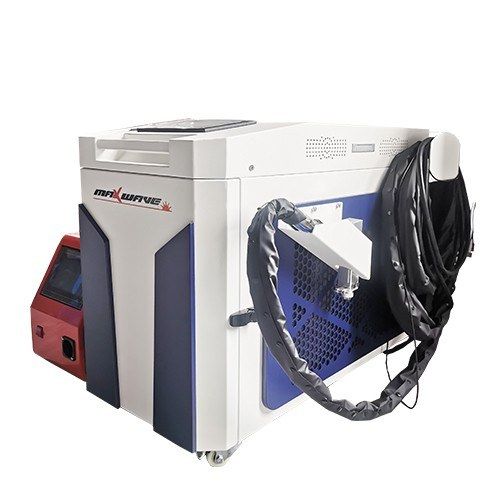
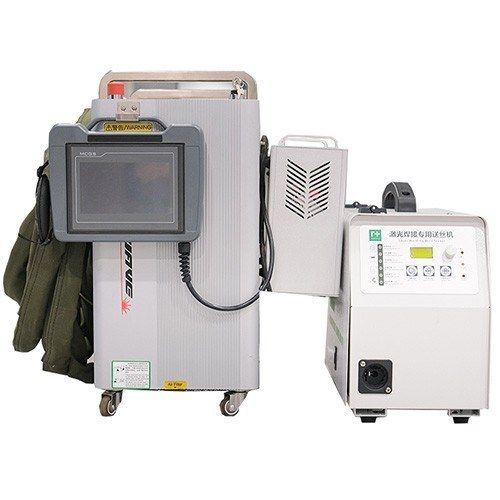
Maxwave builds handheld fiber laser welders from 300 W to 3000 W, including water-cooled units and a model with double wire feed; the laser welding machines page shows part of the range, and other configurations are available on request. To check your alloy and thickness first, send parts for sample testing and we return a test video with the settings used.
Sources
- IPG Photonics: LightWELD handheld laser welding and cleaning (welding capability by alloy series)
- Miller Electric: OptX 2kW handheld laser welder specification sheet, LS/1.0 (aluminium parameters)
- Lincoln Electric: Flex Lase handheld laser welding system, process guide and weld settings (GS-258436)
- Hobart Brothers: Aluminum welding guide (filler selection, non-weldable alloys, porosity, hot cracking)
- TWI Industrial Member Report 1177/2023: Solidification cracking susceptibility of AA6061 and AA2024 aluminium alloys during laser welding
- Kawahito, Matsumoto, Abe and Katayama (2010), Laser absorption of aluminum alloy in high brightness and high power fiber laser welding, Journal of Light Metal Welding 48(1)
- Kang, Han and Kim (2018), Microstructure and solidification crack susceptibility of Al 6014 molten alloy subjected to a spatially oscillated laser beam, Materials 11(4):648
- Kamm et al. (2025), Operando X-ray tomoscopy of laser beam welding, Advanced Science 12(9)
- Messer Griesheim patent US5488216A: Protective gas for the laser welding of aluminum