Short answer
For most small fabrication shops, the best handheld laser welder is a 1500 W fiber unit with a wobble head, a wire feeder and a 220–240 V single-phase supply. It covers 0.5–3 mm steel and stainless, which is most small-shop work. Choose 2000 W if 3–4 mm steel or aluminium is weekly work and your supply can carry it. Judge brands on published settings, input current, what the price includes and a test on your own parts.
Key takeaways
- A 1500 W handheld fiber laser with wobble and a wire feeder covers 0.5–3 mm steel and stainless. Several makers build 1500–2000 W units for a 220–240 V single-phase supply.
- Maxwave estimates travel speeds on stainless of 0.6–1.0 m/min on 2 mm at 1500 W and 0.8–1.3 m/min at 2000 W. The gain from 2000 W grows with thickness, from about a quarter at 1 mm to 60–70% at 4 mm.
- Published reference points: Lincoln's 2 kW presets with filler wire run at 0.30–0.42 m/min on 1–4 mm stainless, and Miller states 0.3–0.5 m/min. A Linde TIG chart for stainless gives 0.20 m/min on 1.6–3.2 mm.
- Published input ratings for 1500–2000 W units on single-phase power run from 24 A at 220 V (IPG LightWELD 1500 XC) to 32–40 A at 240 V (Miller OptX 2 kW). Plan a dedicated circuit.
- In October 2026 a 1500 W unit cost about US$1,700–4,800 on Chinese factory listings, US$5,499.99 at a US retailer on sale, and 2 kW packages from established welding brands US$32,070–47,048.


For most small fabrication shops, the best handheld laser welder is a 1500 W fiber laser with a wobble head, a wire feeder and a 220–240 V single-phase supply. Buy 2000 W when 3–4 mm steel or aluminium is weekly work. The brand matters less than four checks: published settings, input current, what the price includes, and a test weld on your own parts.
Which handheld laser welder fits which shop?
Start from the thickest metal you weld every week and the power supply you already have.
Handheld laser welder by type of small shop
| Your work | Laser power | Cooling | Wire feeder | Power supply |
|---|---|---|---|---|
| Thin stainless, 0.5–2 mm: enclosures, kitchen equipment, signs | 1000–1500 W | Air | For fillets and gaps | 220–240 V single-phase |
| Mixed steel and stainless, 1–3 mm: brackets, frames, railings | 1500 W | Air or water | Yes | 220–240 V single-phase |
| Weekly 3–4 mm steel, or 2–3 mm aluminium | 2000 W | Air or water | Yes | 240 V single-phase on some brands; 380 V on others |
| Mostly plate over 5 mm | 3000 W, or keep MIG | Water | Yes, often double wire | Usually three-phase |
| Several jobs on one cart: weld, clean seams, trim sheet | 1500 W 4-in-1 | Air | Yes | 220–240 V single-phase |
A small shop gains most from a laser on thin, visible work. Low heat input means less distortion and less grinding on stainless. Our laser welding vs TIG and MIG guide covers the jobs where arc welding stays ahead.
How fast does a 1500 W or 2000 W handheld laser weld?
Maxwave estimates these travel speeds on stainless steel, the metal in the sample welds at the top of this page. They are figures for planning, not guaranteed rates. Your joint type, fit-up, filler wire and operator change the result.
Estimated travel speed on stainless steel, Maxwave 1500 W and 2000 W handheld welders
| Thickness | 1500 W | 2000 W | Speed gain from 2000 W |
|---|---|---|---|
| 1 mm | 0.8–1.3 m/min | 1.0–1.6 m/min | About 25% |
| 2 mm | 0.6–1.0 m/min | 0.8–1.3 m/min | About 30% |
| 3 mm | 0.5–0.8 m/min | 0.7–1.1 m/min | About 40% |
| 4 mm | 0.3–0.5 m/min | 0.5–0.8 m/min | About 60–70% |
The gain from 2000 W grows with thickness. On 1 mm sheet, 2000 W is about a quarter faster. On 4 mm it is 60–70% faster. If most of your work is under 2 mm, the extra power buys little.
Turned into time, a 1 m seam in 2 mm stainless takes about 1.0–1.7 minutes of beam-on time at 1500 W and 0.8–1.25 minutes at 2000 W. Fit-up, tacking and handling usually take longer than the weld itself.
How do these estimates compare with published figures?
Few makers publish travel speeds for handheld welding, and those that do measure different things.
Published travel speeds for handheld laser and TIG welding
| Source | Process and conditions | Thickness | Travel speed |
|---|---|---|---|
| Lincoln Electric, Flex Lase 2 kW presets | Laser, stainless with filler wire, 3 mm wobble | 1 / 2 / 3 / 4 mm | 0.42 / 0.36 / 0.30 / 0.30 m/min |
| Miller, OptX 2 kW specification sheet | Laser, one figure for its whole steel range | 20 gauge to 1/4 in | 0.3–0.5 m/min (15–20 in/min) |
| GW LaserTech, 1500/2000 W air-cooled system manual | Laser, stainless butt joint, 2 mm wobble | 1 / 2 / 3 mm | 2.4 / 1.8 / 1.2 m/min |
| Politecnico di Milano thesis (2022) | Laser, hand-held head at 1350 W, 301LN stainless | 2 mm | 1 m/min |
| Linde, TIG parameters for stainless steel | TIG, flat position, filler rod | 1.6 / 2.4 / 3.2 mm | 0.20 m/min (8 in/min) |
Maxwave’s estimates sit between Lincoln’s presets and GW LaserTech’s butt-weld settings. Lincoln’s figures are for welding with filler wire, where its guide sets wire feed speed equal to travel speed. The top of Maxwave’s 1500 W range for 2 mm matches the thesis result of 1 m/min at 1350 W. Expect the lower end of each range, or less, with filler wire, wide gaps or welds out of position.
How much faster than TIG?
On 2–3 mm stainless, Maxwave’s 1500 W estimates are about 2.5–5 times the 0.20 m/min in Linde’s TIG chart. IPG, Lincoln, Miller and Han’s Laser all claim handheld lasers weld up to 4 times faster than TIG. TWI notes that such claims still lack standard, independent test data. Time a few of your own parts before you build a business case on any speed factor.
Should a small shop buy 1500 W or 2000 W?
Buy 1500 W if most of your work is 3 mm or thinner. Buy 2000 W if 3–4 mm steel or aluminium is regular work, because that is where the speed table shows the largest gain.
Three more points decide it in a small shop:
- Thickness. Published maker data puts 1500 W at about 2–3.5 mm steel in daily production and 2000 W at about 3–4 mm. Our power guide has the full table by metal.
- Power supply. Many 2 kW units from Western brands run on 240 V single-phase. Maxwave’s standard water-cooled 2000 W welder is built for 380 V, while its 1000 and 1500 W units run on 220 V. Check your supply first.
- Price. Maxwave’s indicative ex-works prices in October 2026 start at US$3,500 for 1500 W and US$4,400 for 2000 W. The written quotation is binding.
Can a small shop run a laser welder on single-phase power?
Yes, up to about 2000 W with the right machine and a dedicated circuit. These are the published input ratings of handheld welders that small shops often shortlist.
Published input ratings of handheld laser welders, seen October 2026
| Machine | Laser power | Supply | Rated current | Cooling and size |
|---|---|---|---|---|
| xTool MetalFab 800 W | 800 W | 220–240 V | 13.5 A full load; 20 A breaker | Air, 31 kg |
| xTool MetalFab 1200 W | 1200 W | 200–240 V | 4,200 W rated; 25 A breaker | Weight not published |
| IPG LightWELD 1500 XC | 1500 W | 220 V single-phase | 24 A | Air, 53 kg, 641 × 316 × 534 mm |
| Lincoln Flex Lase | 2000 W | 230 V single-phase | 26 A at rated output | Not stated on the sheet |
| Miller OptX 2 kW | 2000 W | 240 V single-phase | 32 A on the spec sheet, 40 A in the FAQ; wire feeder 120 V, 3.5 A | 64 kg net |
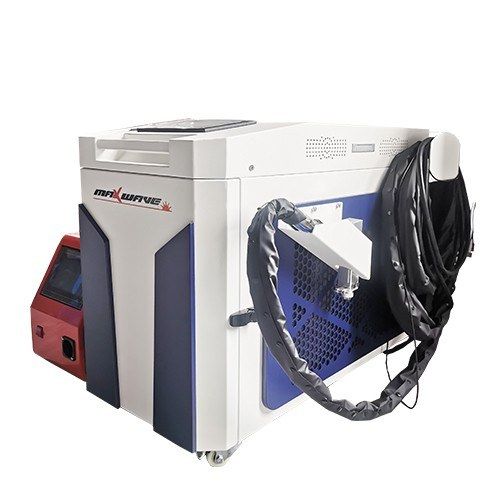
| Maxwave air-cooled MW-HW1500 | 1500 W | 220 V, 50/60 Hz | Ask for the full-load current | Air, 650 × 300 × 570 mm |
| Maxwave water-cooled MW-HW2000 | 2000 W | 380 V, 50/60 Hz | Ask for the full-load current | Water, 700 × 600 × 900 mm |
Before you order, ask every supplier for the full-load current of the whole package, including the chiller and wire feeder. Have an electrician check the breaker, cable size and plug. If you only have single-phase power, say so in your inquiry: Maxwave builds machines for the customer’s voltage and plug on request.
Air-cooled or water-cooled in a small shop?
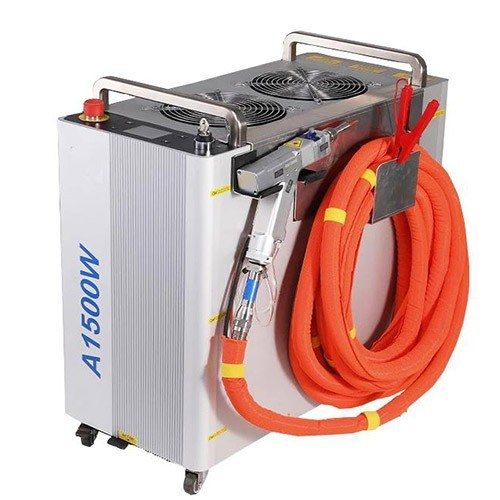
Air cooling suits most small shops. An air-cooled unit has no chiller, no water to change and no freeze risk, and it is easier to move. IPG’s LightWELD 1500 XC weighs 53 kg, and Maxwave’s air-cooled 1500 W cabinet measures 650 × 300 × 570 mm.
Water cooling suits long shifts in hot workshops and 2000 W or more. A chiller holds the laser at a set temperature but adds floor space, power draw and maintenance. Maxwave’s water-cooled cabinet measures about 700 × 600 × 900 mm. Check the rated ambient temperature for either type.
Do you need a wire feeder?
Buy one if you weld fillet joints, aluminium, parts with uneven gaps, or steel over about 3 mm. Without wire, TWI puts the gap a laser butt joint tolerates at about 10% of sheet thickness, or about 0.2 mm on 2 mm sheet. Wobble raises this to about 20–30%, and filler wire to about 100% on steel up to 6 mm.
Wire costs speed. Lincoln’s wire presets run at 0.30–0.42 m/min on 1–4 mm stainless, below Maxwave’s estimates above. Our power guide covers wire sizes and wobble settings.
Which handheld laser welder is best for aluminium?
For regular aluminium work, choose 2000 W with a wire feeder and argon shielding. Aluminium reflects the beam until a keyhole forms and conducts heat away fast, so it needs more power than steel of the same thickness. Lincoln’s 2 kW presets weld aluminium up to 2 mm without wire and 4 mm with wire.
GW LaserTech’s manual shows the speed cost. Its 2 mm aluminium butt weld runs at 100% power and 1.2 m/min, against 90% and 1.8 m/min for 2 mm stainless. Maxwave has not published aluminium speeds, so send a sample of your alloy for a test weld. Our aluminium guide covers alloys, filler wire and porosity.
Is a 4-in-1 welder worth it for a small shop?
It is if you also clean weld seams, remove rust or trim thin sheet, and you have room for one machine. Maxwave’s 1500 W 4-in-1 machine welds stainless up to 5 mm, cuts 1–2 mm sheet and cleans a 20 mm path. Its indicative ex-works price starts at US$3,800, against US$3,500 for a weld-only 1500 W unit. For large-area rust or paint removal, a dedicated laser cleaner works faster. See our 3-in-1 guide.
How much space and safety equipment does a small shop need?
You need a laser controlled area, not necessarily a separate room. Handheld laser welders are Class 4 lasers, so plan for:
- opaque walls or laser-rated curtains around the welding area, with controlled entry;
- eyewear rated for the laser’s wavelength and power, for everyone inside;
- fume extraction at the weld;
- a named person responsible for laser safety, and trained operators.
A screened corner of the workshop is often enough. Our handheld laser safety guide covers eyewear ratings, curtains and interlocks.
What is the best laser welder for the money?
The best value is the machine that includes everything you need and passes a test on your parts at a landed cost you can recover. Listed prices in October 2026 fell into three tiers:
- Chinese factory listings: about US$1,700–4,800 for a 1500 W set, before freight, duty and VAT. Maxwave’s indicative ex-works prices start at US$3,500 for 1500 W.
- US retail brands: US$4,699 for the xTool MetalFab 800 W, US$7,999 for the 1200 W, and US$5,499.99 for OMTech’s 1500 W unit on sale.
- Established welding brands: US$32,070 for Lincoln’s 2 kW Flex Lase Ready-Pak and US$47,048 on sale for Miller’s OptX 2 kW package.
Higher prices buy local service, documented presets and a full safety kit. Compare warranty terms and parts supply as well as price. Our price guide covers landed cost, running cost and payback.
How to judge handheld laser welder reviews and “best” lists
Most “best handheld laser welder” lists that ranked on Google in October 2026 came from makers or sellers, and none we read showed test welds or measured data. This guide also comes from a maker. Check any recommendation, including ours, against the same questions:
- Does the maker publish settings or travel speeds for your metal and thickness?
- What is the full-load current, and does it match your supply?
- Does the price include the wobble head, wire feeder, chiller, spare windows, nozzles and eyewear?
- Who supplies parts and service in your country, and how fast?
- Will the supplier weld your own parts and send a video with the settings used?
A quote that cannot answer these is not a bargain at any price. Our import checklist covers buying from China.
Checklist before you buy
- List your five most common jobs by metal, thickness, joint type and weekly volume.
- Choose the power: 1500 W for work up to about 3 mm, 2000 W for regular 3–4 mm steel or aluminium.
- Confirm your supply voltage, phase and spare current with an electrician.
- Add a wire feeder for fillets, gaps, aluminium or steel over 3 mm.
- Choose air or water cooling for your room temperature and shift length.
- Plan the laser controlled area, eyewear and fume extraction.
- Get a test weld on your own parts, with the speed and settings written down.
Maxwave builds handheld fiber laser welders from 300 W to 3000 W, including air-cooled 1000–1500 W units and a 1500 W 4-in-1 machine; see the laser welding machines range. This site shows only part of the range, and other configurations are available on request. To check speed and quality on your own parts, send samples through sample testing and we return a test video with the settings used.
Sources
- Lincoln Electric: Flex Lase handheld laser welding system, process guide and weld settings (GS-258436)
- Lincoln Electric: Flex Lase product specification sheet (E22.07)
- Miller Electric: OptX 2 kW handheld laser welder specification sheet (LS/1.0, May 2026)
- Miller Electric: OptX 2kW fact sheet and FAQs
- IPG Photonics: LightWELD 1500 XC datasheet (2021)
- Han's Laser: HW-D handheld laser welder
- IPG Photonics: LightWELD handheld laser welding and cleaning
- xTool: MetalFab product specifications (800 W)
- xTool: Power requirements for MetalFab products in different countries and regions
- GW LaserTech: YLPS-Weld-1500/2000-A air-cooled handheld laser welding system, user manual V2.01 (2024), section 6.6
- Borzoni (2022), Technological readiness assessment of hand-held laser welding applied to AISI 301LN products with aesthetic requirements, Politecnico di Milano
- Linde: What are the TIG welding parameters for stainless steel?
- EWI: How much laser power do you need for welding?
- TWI: How can I increase the tolerance of laser welding to joint fit-up?
- TWI (2026): Meeting held for handheld laser welding project