Short answer
A standard Q-switched fiber laser is enough for serial numbers, logos, 2D codes and engraving on metal. Choose a MOPA fiber laser when you need colour marks on stainless steel, grey-to-black marks on natural anodized aluminium, or cleaner marks on plastics and thin parts, because MOPA lets you set the pulse width (2–500 ns on common sources) separately from the frequency.
Key takeaways
- A MOPA (master oscillator power amplifier) fiber laser lets you set pulse width and frequency independently. JPT's M7 20–100 W sources list 2–500 ns and 1–4000 kHz.
- A Q-switched fiber laser has a pulse width fixed at the factory and a narrow frequency band. Raycus lists 90–110 ns at 20–60 kHz for its 20 W RFL-P20QB.
- Pulse energy = average power ÷ frequency, and peak power ≈ pulse energy ÷ pulse width. Short MOPA pulses keep peak power high while each pulse carries far less energy, so less heat goes into the part.
- Laser colour marks on stainless steel are thin oxide films. Most colours repeat well under fixed settings, but acids, salt solutions and hot or freezing humid conditions can degrade some of them, and badly chosen settings can reduce corrosion resistance.
- For colour marking, black on anodized aluminium and plastics, 20–30 W is enough. Pay for 50–100 W only when you need deep engraving or short cycle times.
A standard Q-switched fiber laser is enough if you mark serial numbers, text, logos and 2D codes, or engrave bare metal. Choose a MOPA fiber laser if you need colour on stainless steel, grey-to-black marks on natural anodized aluminium, or cleaner marks on plastics and thin parts. Both lasers work at 1064 nm. The difference is pulse control: a MOPA source lets you set the pulse width separately from the frequency, while a Q-switched source has one fixed pulse width.
MOPA vs Q-switched fiber laser at a glance
| Feature | Q-switched fiber (standard) | MOPA fiber |
|---|---|---|
| Wavelength | 1064 nm | 1064 nm |
| Pulse width | Fixed. Raycus lists 90–110 ns for a 20 W model and 250–290 ns for a 100 W model | Adjustable. JPT M7 20–100 W: 2–500 ns |
| Pulse frequency | Narrow band: 20–60 kHz (20 W) and 80–120 kHz (100 W) on those Raycus models | 1–4000 kHz on JPT M7 |
| Maximum pulse energy | 1 mJ on both Raycus models | 1 mJ (20 and 30 W), 2 mJ (60 W), 1.5 mJ (100 W) on JPT M7 |
| Best at | Codes, text, logos and engraving on metal | All of that, plus colour on stainless, black on anodized aluminium, plastics and thin parts |
| Machine price | Lower | Higher for the same power |
Figures are from the makers’ published datasheets, seen in October 2026. Other models differ, so check the datasheet of the exact source fitted to your machine.
What does MOPA mean?
MOPA stands for master oscillator power amplifier. A small seed laser (the master oscillator) makes the pulses, and fiber amplifiers raise them to full power. Because the seed is switched electronically, the controller can change pulse width and frequency independently. JPT describes its M7 marking sources this way, with 2–500 ns and 1–4000 kHz available on every model from 20 to 100 W.
A Q-switched laser works differently. Energy builds up in the gain fiber while a switch inside the resonator blocks lasing. When the switch opens, the stored energy leaves as one strong pulse. RP Photonics explains that pulse energy and duration depend on the stored energy, and that higher repetition rates usually give longer, weaker pulses. So a Q-switched marker has one built-in pulse width and works well only in a narrow frequency band. The width also differs between models: Raycus lists 90–110 ns for its 20 W source and 250–290 ns for its 100 W source.
Both types are fiber lasers, although listings often call only the Q-switched one “fiber”. Ask whether the pulse width can be adjusted, and in what range.
Why does pulse width matter?
Pulse width decides how the same average power reaches the part. Two formulas explain most of it:
- Pulse energy (J) = average power (W) ÷ frequency (Hz)
- Peak power (W) ≈ pulse energy (J) ÷ pulse width (s)
The second formula treats the pulse as a rectangle, so it is an estimate. Real pulses have a peak and a tail.
| Example setting | Pulse energy | Approx. peak power |
|---|---|---|
| Q-switched, 20 W, 20 kHz, 100 ns | 1 mJ | 10 kW |
| Q-switched, 20 W, 60 kHz, 100 ns | 0.33 mJ | 3.3 kW |
| MOPA, 20 W, 500 kHz, 8 ns | 40 µJ | 5 kW |
| MOPA, 10 W, 200 kHz, 8 ns | 50 µJ | 6 kW |
A long, energetic Q-switched pulse melts and removes metal well, which suits engraving and deep marks. A short MOPA pulse still has enough peak power to mark, but it carries far less energy. Less heat spreads into the part. That is what you need for an oxide colour, a dark mark under anodizing, or a plastic that should not char.
At very short pulse widths each pulse carries little energy, so full average power needs a high frequency. Check the source manual’s frequency range for each pulse width before you copy a recipe from another machine.
Which marking jobs need MOPA?
Colour on stainless steel, black on natural anodized aluminium, plastics and thin parts benefit from MOPA. Codes, logos and engraving on metal do not.
| Task | Q-switched fiber OK? | MOPA better? |
|---|---|---|
| Serial numbers, logos, 2D codes on steel | Yes | No real gain |
| Deep engraving on steel or brass (moulds, VIN plates) | Yes | Similar at the same power |
| White mark on coloured anodized aluminium (layer removed) | Yes | Similar |
| Grey or black mark on natural anodized aluminium | Weak: removing the layer gives low contrast | Yes |
| Colour marks on stainless steel | Limited: a few tones at slow speed | Yes: wider palette and more control |
| Colour on titanium | Limited, test first | Yes |
| Dark, smooth marks on stainless (tools, medical parts) | Possible | Better control of heat input |
| Engineering plastics (ABS, PC, PA, PBT) | Often, with risk of burning or foaming | Usually cleaner; depends on the grade |
| White, clear or flame-retardant plastics | Poor | Limited; use UV |
| Foils, thin sheet, small electronic parts | Risk of heat damage | Yes: low pulse energy |
| Glass, wood, textiles | No | No |
For the full material matrix across fiber, MOPA, UV and CO2 lasers, see fiber vs UV vs CO2 laser marking.
How does a MOPA laser make colours on stainless steel?
The laser heats the surface just enough to grow a thin oxide film without melting it, and the film’s thickness and chemistry set the colour. Published studies report films from about 20 nm to 0.8 µm thick. Light reflected from the top and bottom of the film interferes, which shifts the colour as the film grows. A 2017 study in Scientific Reports found that the oxide chemistry (chromium, iron, manganese and nickel oxides) also contributes strongly to the colour.
The colour follows the heat input per area. That heat depends on power, speed, frequency, pulse width, line spacing (hatch), number of passes and focus. Two studies show the range of settings involved:
- Lu et al. (2017) used a 20 W, 1064 nm nanosecond fiber laser with 4–260 ns pulse width. They set colours on AISI 304 by changing scan speed (100–1300 mm/s), frequency (45–500 kHz) and pulse width. Each 5 × 5 mm colour square took about 1 minute.
- Lazov et al. (2026) kept a 20 W fiber laser at a fixed 100 ns and 20 kHz. They got yellow, green and blue shades on AISI 304 by changing only speed (25–125 mm/s), line spacing (20–80 µm) and passes (1–3). Line spacing had the strongest effect on colour.
The second study shows that pulses as long as a Q-switched laser’s can colour steel at low speed. Adjustable pulse width gives a MOPA laser one more way to control heat input, and so a wider working window.
What is a MOPA colour chart?
A colour chart is a test grid, with each square marked at a different combination of speed, frequency, pulse width and line spacing. Published charts are only a starting point, because the result changes with the alloy, surface finish, lens, focus height and source. Mark your own grid on the real material, record the settings beside each square, and lock the lens and focus height before production.
How repeatable and durable are colour marks?
Colour marks repeat well when everything is fixed, but they are thin surface films. They are less durable than an engraved mark.
- Repeatability. In a 2020 IEEE Access study, a 15-colour palette on AISI 304 showed high repeatability for every colour except one.
- Chemicals and climate. The same marks were hard and resisted mechanical impact and most chemicals. Acidic solutions and salts were the exceptions. A few colours deteriorated at 100 °C and 90% humidity, and at −40 °C and 90% humidity.
- Corrosion. Sandia National Laboratories tested nanosecond-laser oxide marks on 304L in chloride solutions. Single-layer oxides outside a thickness window of about 100–150 nm tended to dissolve. The steel just under the oxide corroded severely because laser melting had depleted its chromium. Multilayer marks made at 475 mm/s resisted corrosion better than those made at 550 mm/s, so small changes in settings matter.
- Viewing angle. Lu et al. found that colours look slightly different when the part is tilted.
For food equipment, marine hardware or reusable medical parts, run your own corrosion or cleaning test, or use an engraved or dark annealed mark instead of colour.
How do you get a black mark on anodized aluminium?
Use short pulses at high frequency with very tight line spacing, so the mark darkens without removing the anodized layer. A standard fiber laser removes the layer and leaves a white mark. Trotec notes that this suits coloured anodizing, but the white mark is hard to see on natural (clear) anodizing.
Trotec publishes this starting recipe for a 20 W MOPA source with a 254 mm focal-length lens:
- Power 50% (about 10 W), speed 1500 mm/s, frequency 200 kHz, pulse width 8 ns, in focus, one pass
- Line spacing 0.001 mm (bidirectional) for a rich black, or 0.002–0.005 mm for grey tones
Trotec also warns that anodized layers vary a lot, so the same settings can give a different result on parts from another anodizer. Check new batches under magnification for cracks in the layer, and wipe or rub-test the mark.
Does a MOPA laser mark plastics with less burning?
Often yes, because short pulses put less energy into the plastic, so less heat spreads around the mark. The result depends heavily on the plastic grade, pigments and additives. A setting that gives a crisp mark on one black ABS can foam another. Start with a short pulse, high frequency and low power, then raise the energy step by step until the contrast is good enough. For white, clear or flame-retardant grades, a UV laser is usually the better choice.
What settings should you start from?
Start from a published recipe, then build a test grid on your own part:
| Job | Pulse width | Frequency | Speed | Line spacing | Source |
|---|---|---|---|---|---|
| Colour on 304 stainless, 20 W MOPA | 4–260 ns explored | 45–500 kHz | 100–1300 mm/s | Varied | Lu et al. 2017 |
| Colour on 304 stainless, fixed pulse, 20 W | 100 ns | 20 kHz | 25–125 mm/s | 20–80 µm, 1–3 passes | Lazov et al. 2026 |
| Black on natural anodized aluminium, 20 W MOPA | 8 ns | 200 kHz | 1500 mm/s | 0.001 mm (black), 0.002–0.005 mm (grey) | Trotec |
Change one parameter at a time. Keep the lens, focus height and material batch fixed, and write the settings on every test square.
Which power: 20, 30, 50, 60 or 100 W?
For colour marking, black on anodized aluminium and plastics, 20–30 W is enough. The studies above made colours with 20 W sources, and Trotec’s black recipe uses half of a 20 W source.
- 20–30 W. Colour, black on anodized aluminium, plastics, codes and logos. JPT’s 20 and 30 W M7 sources deliver up to 1 mJ per pulse.
- 50–60 W. Faster fill marking, deeper engraving and larger lens fields. In JPT’s M7 range, the 60 W model has the highest pulse energy (2 mJ).
- 100 W. Deep engraving and production lines where cycle time decides. The JPT 100 W model is rated at 1.5 mJ.
Extra watts buy speed and depth. They do not widen the colour palette, and a larger lens field spreads the same power over a larger spot.
Is MOPA worth the extra money?
Yes, if at least one of your regular jobs is in the MOPA column of the table above. If not, a Q-switched marker of the same power does the work for less. A MOPA machine costs more than a Q-switched machine of the same power and format. The extra cost is in the laser source. For current price ranges, see how much a laser marking machine costs.
If you also mark white plastics, glass or PCBs, a UV marker may be a better second machine than paying more for MOPA.
What are the limits of MOPA marking?
MOPA keeps the wavelength limits of any fiber laser, and its colour marks need tight process control.
- Same wavelength. MOPA cannot mark clear glass and is poor on wood and textiles, just like any 1064 nm fiber laser.
- Colour is not printing. You cannot match a set colour standard exactly. The palette depends on the alloy, surface finish and settings.
- Colour is slow. Lu et al. needed about 1 minute per 5 × 5 mm colour square. Trotec’s black recipe covers about 1.5 mm² per second (1500 mm/s × 0.001 mm line spacing).
- Durability and drift. Colour marks are thin oxide films, so an engraved mark lasts longer under abrasion, acids and salt. The colour drifts if focus height, lens, speed or material batch change.
How to decide
- List every material and finish you mark, and the contrast, colour and depth each one needs.
- Only grey marks, codes and engraving on metal: choose a Q-switched fiber marker.
- Colour on stainless steel or titanium, black on natural anodized aluminium, plastics or thin parts: choose MOPA.
- White, clear or flame-retardant plastics, glass or PCBs: add a UV marker.
- Choose 20–30 W for colour and fine work, and 50–100 W only for depth or throughput.
- Ask for the source model code and its pulse width and frequency ranges in writing.
- Test your real parts, including the corrosion or cleaning cycle they will face.
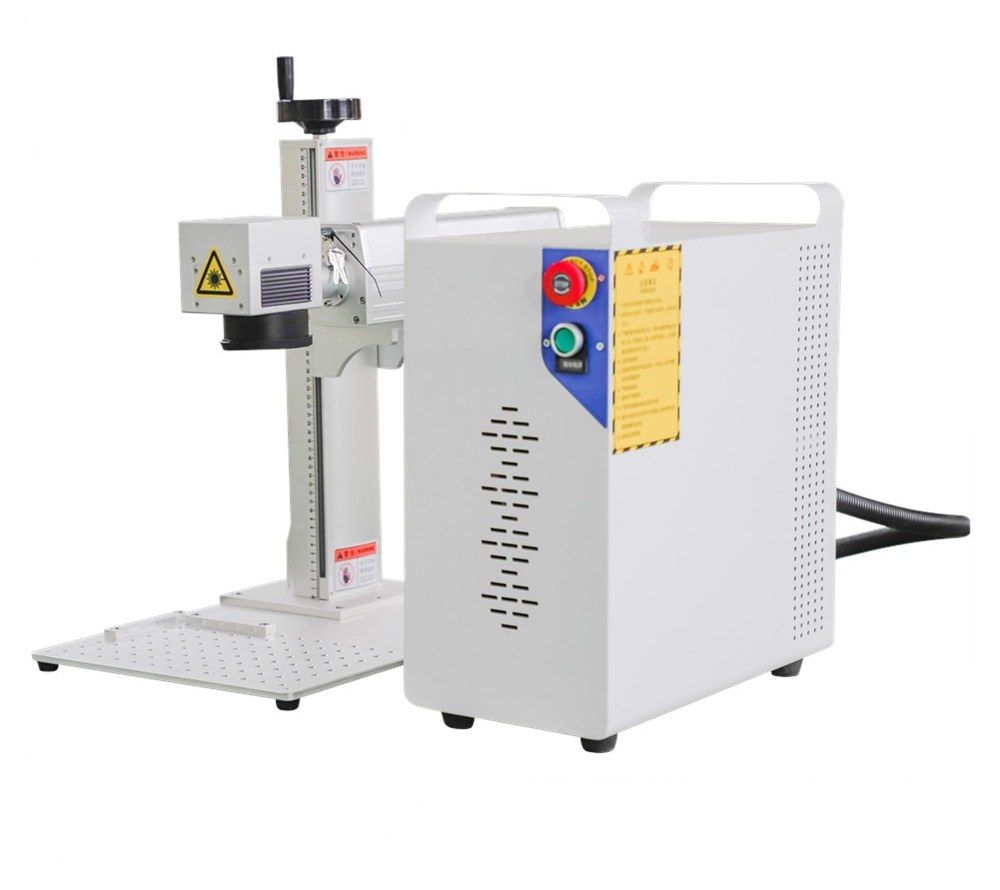
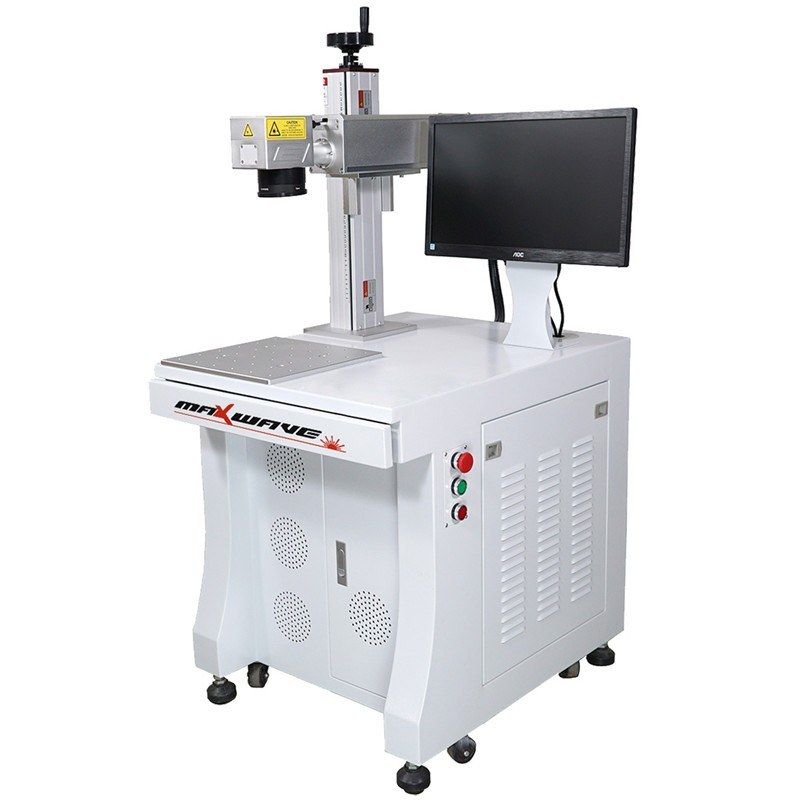
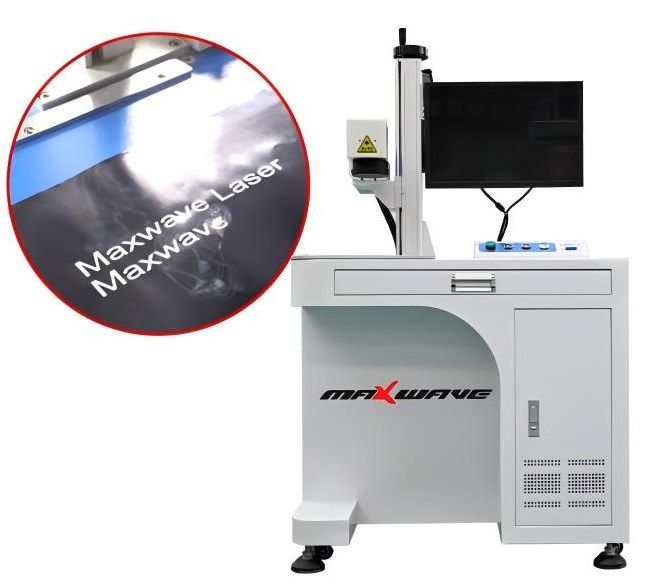
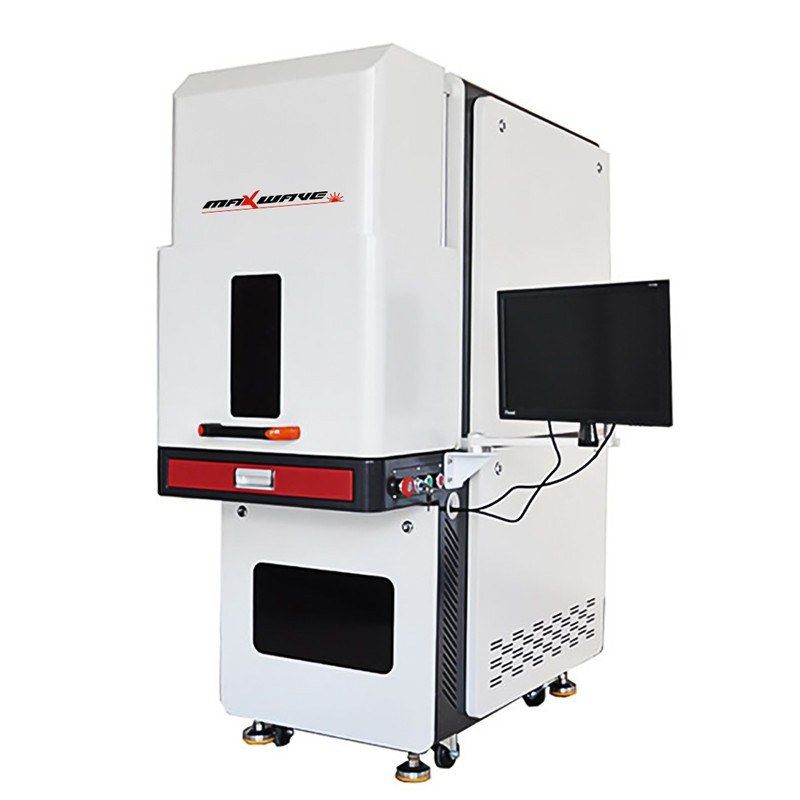
Maxwave builds MOPA markers from 20 to 100 W alongside standard fiber, UV and CO2 markers, listed under laser marking machines; the site shows only part of the range, and other configurations are available on request. To see whether your part needs MOPA, use sample testing and get back a test video and the settings used.
Sources
- JPT Opto-electronics: M7 20–100 W MOPA fiber lasers, specifications (YDFLP-E2-20/30/60/100-M7)
- Raycus: RFL-P20QB 20 W Q-switched pulse fiber laser, specifications
- Raycus: RFL-P100QA 100 W Q-switched pulse fiber laser, specifications
- RP Photonics Encyclopedia: Q-switching
- Lu et al., Nanosecond laser coloration on stainless steel surface, Scientific Reports 7, 7092 (2017)
- Lazov et al., Influence of laser marking parameters on color generation in AISI 304 stainless steel, Materials 19(3), 612 (2026)
- Lawrence, Adams, Bahr, Moody (Sandia National Laboratories), Environmental resistance of oxide tags fabricated on 304L stainless steel via nanosecond pulsed laser irradiation, Surface and Coatings Technology 285 (2015)
- Roozbahani, Alizadeh, Handroos, Salminen, Color laser marking: repeatability, stability and resistance against mechanical, chemical and environmental effects, IEEE Access 8 (2020)
- Trotec help center: Black marking on anodized aluminum (MOPA parameters)