Short answer
Listed US retail prices seen in October 2026 put an open 20–50 W Q-switched fiber laser marker at about $1,600–3,000. MOPA markers ran from about $2,000 at 20 W to about $12,000 at 200 W, UV markers about $2,700–14,000, RF CO2 galvo markers about $2,800–9,000, and an enclosed US-brand MOPA workstation $17,000–26,000, all before freight, import taxes, fume extraction and safety equipment.
Key takeaways
- In October 2026, US retailers listed open 20–50 W Q-switched fiber laser markers at about $1,600–3,000 each, before shipping and sales tax.
- On one retailer's listings, a MOPA source added about $600–800 to a 20–30 W marker of the same format; at component level a 20 W JPT M7 MOPA source was $2,549 against $949–999 for a 20 W Q-switched source.
- UV costs the most per watt: 5–10 W UV markers were listed at about $2,700–8,000, and a 5 W UV source alone at $2,599–3,899.
- The HS code changes the import bill: Bangladesh's tariff shows a total tax incidence of 28.73% under 8456.11.00 and 33.63% under 9013.20.00 (lasers).
- Budget for the system, not the laser alone: fume extraction, wavelength-rated eyewear or an enclosure, a rotary axis, software, freight and import taxes.
An open desktop fiber laser marking machine with a 20–50 W Q-switched source cost about $1,600–3,000 in US retail listings seen in October 2026. MOPA markers ran from about $2,000 to $12,000 depending on power, UV markers about $2,700–14,000 and RF CO2 galvo markers about $2,800–9,000. Enclosed workstations from an established US brand started near $17,000. Freight, import taxes, fume extraction and safety equipment come on top of all of these.
Laser marking machine prices at a glance
These are listed prices seen in October 2026 on US retail and manufacturer websites. They are in US dollars, for one machine, before shipping and sales tax. Where a seller showed a sale price next to a higher “regular” price, the table uses the sale price.
| Machine | Power | Listed price (USD) | Where seen |
|---|---|---|---|
| Fiber, Q-switched, open desktop or integrated | 20 W | 1,600–1,800 | OMTech |
| Fiber, Q-switched | 30 W | 1,900–2,200 | OMTech |
| Fiber, Q-switched | 50 W | 2,100–3,000 | OMTech |
| Fiber, MOPA | 20–30 W | 2,000–3,000 | OMTech |
| Fiber, MOPA | 60–80 W | 3,600–6,000 | OMTech, Cloudray |
| Fiber, MOPA | 100 W | 5,900–8,500 | OMTech, Cloudray |
| Fiber, MOPA | 200 W | about 12,000 | Cloudray |
| UV, 355 nm | 5–6 W | 2,700–5,000 | Monport, Cloudray |
| UV, 355 nm | 10 W | 4,400–8,000 | Monport, Cloudray |
| UV, 355 nm | 15 W | about 14,000 | Cloudray |
| CO2 galvo, RF metal tube | 30 W | about 2,800 | Cloudray |
| CO2 galvo, RF metal tube | 60 W | about 9,000 | Cloudray |
| Enclosed MOPA workstation, US brand | 30–100 W | 17,000–26,000 | Epilog Fusion Galvo G100 |
How to read the table:
- The low end is open-frame machines sold online. You add extraction, a safe work area and fixtures yourself.
- Retail prices move often. OMTech showed struck-through “regular” prices from about 15% to just over 100% above the sale price.
- US retail prices already include the seller’s cost of getting the machine into the US. A factory quote from China is usually ex-works or FOB, so freight, insurance, duty and local tax are still to come.
How much does a 20 W, 30 W or 50 W fiber laser marker cost?
A 20 W open fiber marker was listed at about $1,600–1,800, a 30 W at about $1,900–2,200 and a 50 W at about $2,100–3,000. On OMTech’s compact integrated models the power steps were small: $1,599.99 for 20 W, $1,899.99 for 30 W and $2,099.99 for 50 W, each with a 150 × 150 mm (5.9 × 5.9 in) field or smaller. The 50 W split model with a 200 × 200 mm (7.9 × 7.9 in) field was $2,999.99.
For surface marks such as serial numbers, logos and 2D codes on metal, 20–30 W is usually enough. Choose 50 W or more for deep engraving, larger fields or short cycle times.
How much more does a MOPA laser marker cost?
At 20–30 W, a MOPA source added about $600–800 on OMTech’s listings, compared with a Q-switched machine of the same power and format. For example, the 30 W compact model with a 150 × 150 mm field was $1,899.99 with a Q-switched source and $2,599.99 with MOPA. The gap starts at the source: Cloudray listed a 20 W JPT M7 MOPA source at $2,549, while 20 W Q-switched sources from MAX and Raycus started at $949 and $999.
Above 50 W, most retail markers in the table are MOPA. MOPA pays off when you need colour on stainless steel, black marks on anodized aluminium or cleaner marks on plastics. For plain serial numbers on steel it adds cost without a clear benefit. Our MOPA vs Q-switched guide explains the difference.
How much does a UV laser marking machine cost?
UV markers cost the most per watt. Monport listed a 6 W UV galvo machine at $2,719.99 and a 10 W at $4,369.99, both with a water chiller. Cloudray listed water-cooled UV machines with autofocus at $4,999 for 5 W, $7,999 for 10 W and $13,999 for 15 W.
The reason is the source. Cloudray listed 5 W, 355 nm UV sources at $2,599–3,899. A 30 W Q-switched fiber source from Raycus was $1,099 on the same site. See fiber vs UV vs CO2 laser marking for the materials that need UV.
How much does a CO2 galvo laser marking machine cost?
Cloudray listed an RF metal-tube CO2 galvo marker at $2,799 for 30 W and $8,999 for 60 W, with US plugs. CO2 markers suit wood, leather, paper, acrylic, glass and coated metal, but not bare metal.
We found few published prices for 80–150 W glass-tube CO2 galvo markers, used for denim, leather and large wood parts. Get quotes and compare tube type and expected tube life.
Desktop, cabinet, handheld or online: how does format change the price?
The open desktop format is the cheapest. Enclosure, portability and line integration each add hardware.
| Format | What you pay for | Price evidence (October 2026) |
|---|---|---|
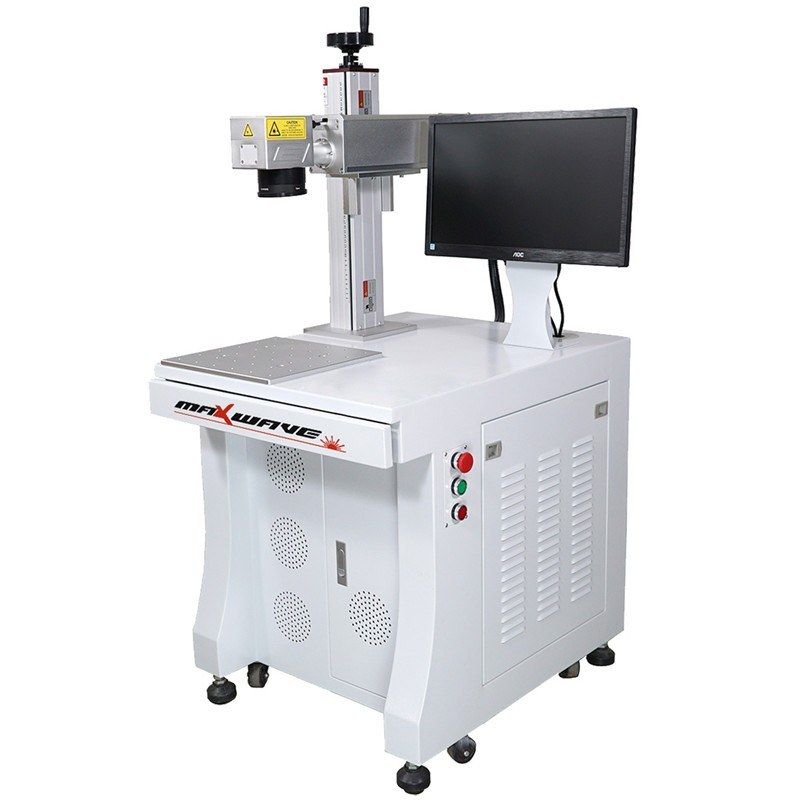
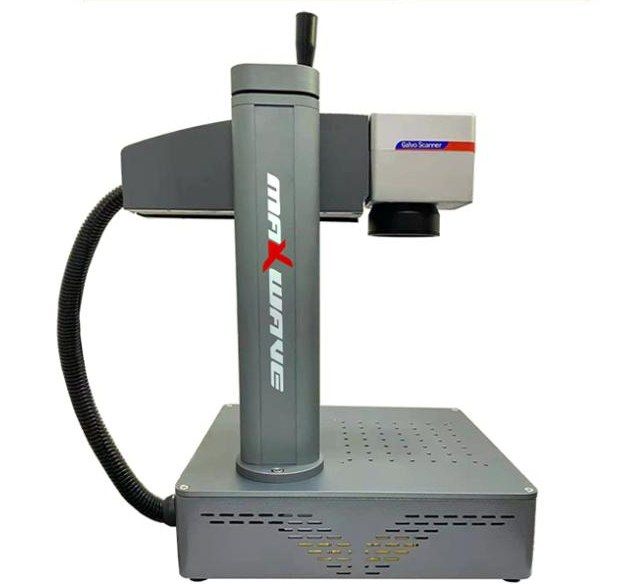
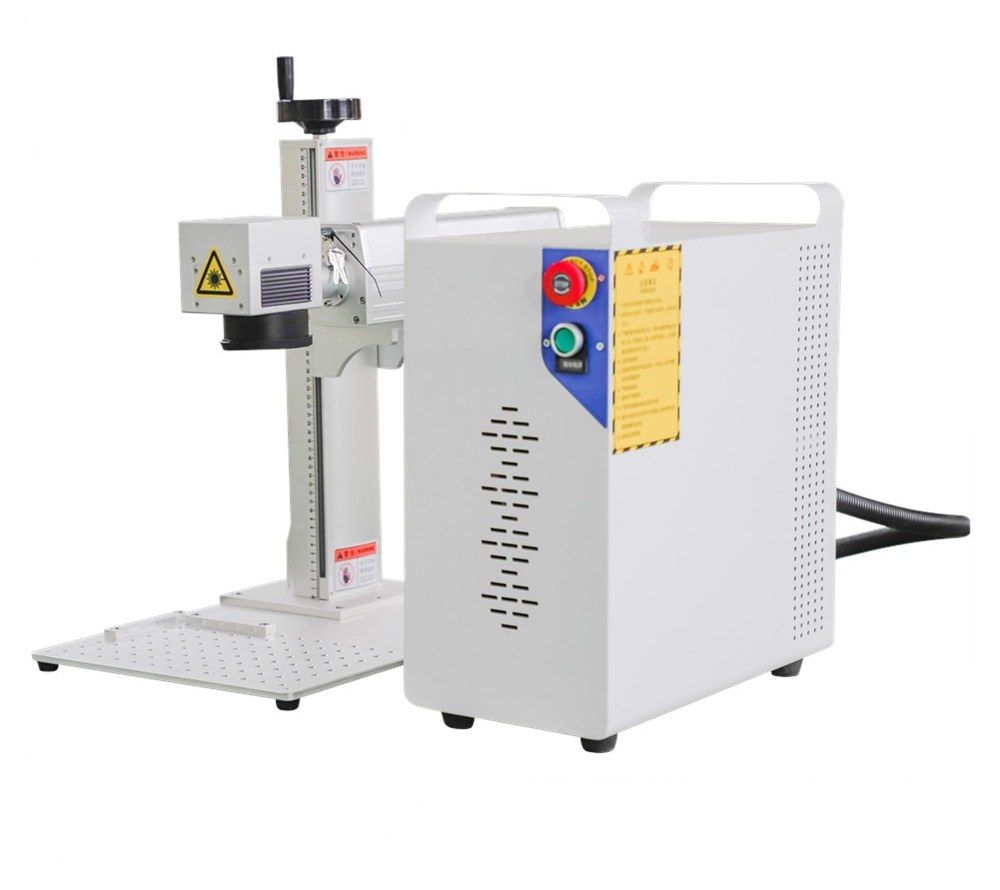
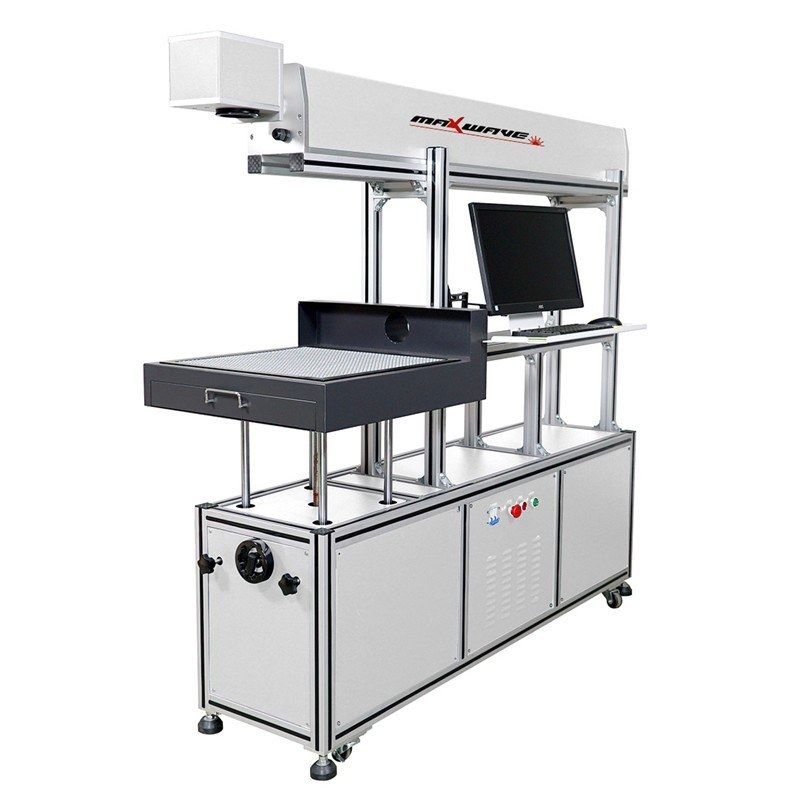
| Open desktop, split or integrated | Galvo head on a column, source and controller in a base or separate box | $1,600–3,000 for 20–50 W fiber |
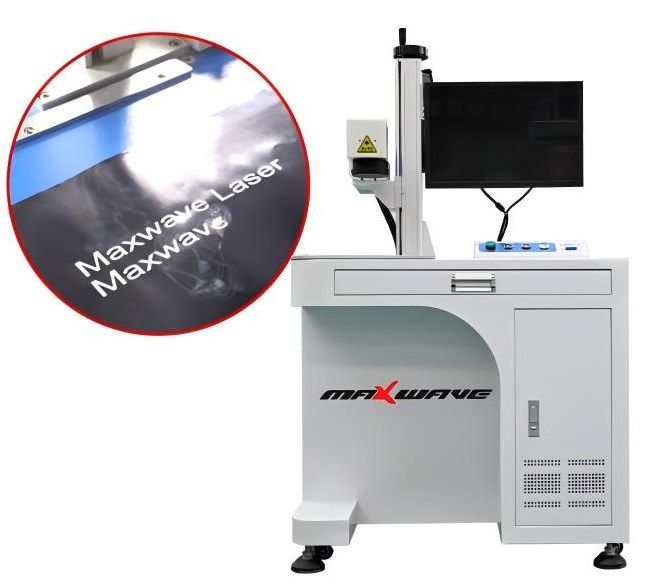
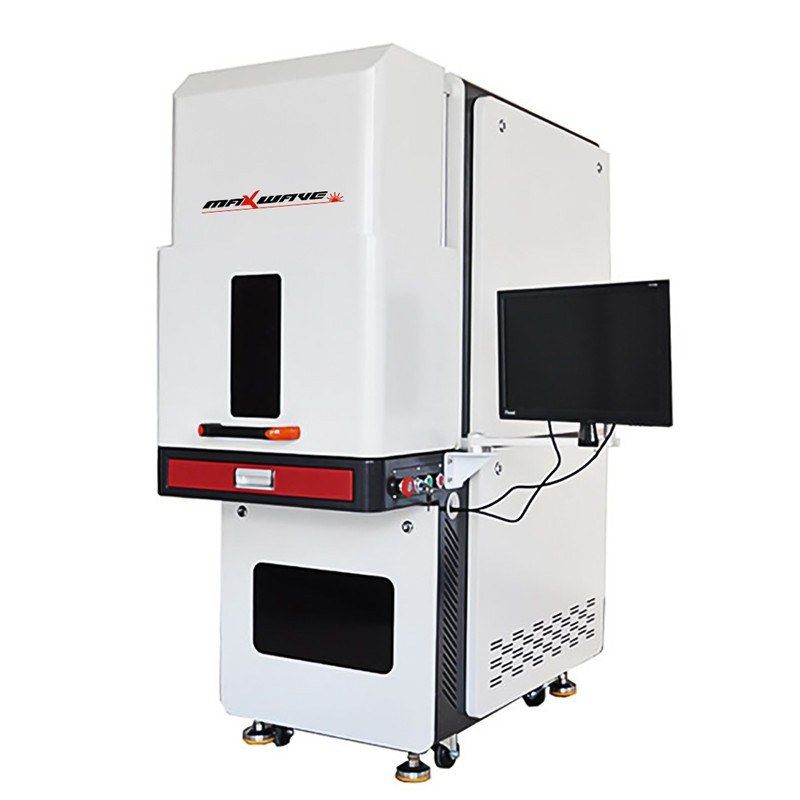
| Enclosed cabinet or workstation | Enclosure with door, extraction port, lower laser class possible | Epilog G100: $16,995 (30 W MOPA) to $25,995 (100 W MOPA) |
| Handheld or portable | Head on a cable or light frame, portable source box | Rarely published; get quotes |
| Online or flying | Encoder, product sensor, mounting, PLC signals, on-the-fly software | Quoted with the production line |
An open 20 W marker is a Class 4 laser product, so it needs eyewear rated for the wavelength and a controlled area. A fully enclosed machine can carry a lower class. Epilog lists its G100 as a Class 2 laser product, with an automated mechanical door. Our laser safety guide covers what each class requires.
What drives the price of a laser marking machine?
- Laser source type and brand. A 20 W Q-switched source alone was listed at $949–999 as a spare part, which is more than half the price of a complete 20 W retail machine. Ask for the source brand and model on the quote, for example Raycus, JPT, MAX or IPG, and check its pulse range and warranty.
- Power. Steps are small at low power and larger at high power. OMTech’s split MOPA went from $4,099.99 at 60 W to $5,899.99 at 100 W.
- MOPA or Q-switched. About $600–800 extra at 20–30 W on the same retailer’s listings.
- Galvo head, lens and field size. Ask which field lenses are included and whether a second lens is extra.
- Software. Many markers ship with EZCAD. OMTech’s LightBurn bundles cost $0–200 more, depending on the model. 2.5D and 3D engraving need software and a controller that support it.
- Accessories. A rotary axis for rings, cups and pipes, and a fume extractor, are often sold as bundle options. The running-cost table below gives listed prices.
- Warranty and support. Epilog’s 2-year warranty covers all parts including the laser source. Ask every supplier, in writing, whether the source is covered and for how long.
What does a laser marker cost in India, Pakistan, Bangladesh or Sri Lanka?
The landed cost is the machine price plus freight and insurance, customs duty, other levies, VAT or GST, and clearing and local delivery. The rates depend on the HS code that customs accepts. We do not quote local market prices; get a supplier quote and ask a clearing agent to price the import.
The calculation works roughly like this, although each country defines its own tax base:
- CIF value = machine price + export handling + international freight + insurance
- Customs duty = CIF value × duty rate
- VAT or GST = (CIF value + duty + other levies) × tax rate
- Landed cost = CIF value + duty + levies + VAT or GST + clearing and inland delivery
The official tariffs showed these rates in October 2026:
| Country | Customs duty, laser machine tools (HS 8456.11) | VAT, GST and other levies listed | Official source |
|---|---|---|---|
| India | Basic customs duty set in the Customs Tariff; check CBIC’s ICEGATE duty calculator | GST 18% (9% CGST + 9% SGST) for heading 8456 and for lasers under 9013 | GST Council rate schedule |
| Pakistan | 0% for PCT 8456.1190; also 0% for lasers under 9013.2000 | Sales tax and other import levies apply; ask your clearing agent | FBR, Pakistan Customs Tariff FY 2026-27 |
| Bangladesh | 1% for 8456.11.00; 5% if classed as a laser under 9013.20.00 | VAT 15%, advance income tax 5%, advance tax 7.5%; total tax incidence 28.73% (33.63% under 9013.20.00) | NBR operative tariff and duty calculator |
| Sri Lanka | Free for 8456.11 | VAT 18%, Ports and Airports Development Levy 5%, SSCL 2.5% | Sri Lanka Customs, Imports Tariff Guide 2026 |
Worked example for Bangladesh: a marker with a CIF value of $3,000 entered under 8456.11.00 attracts about $3,000 × 28.73% = $862 in duties and taxes. If customs classify it as a laser under 9013.20.00, the figure is about $3,000 × 33.63% = $1,009. Ask your accountant which of these taxes your business can recover.
Other things that change the final price in any market:
- Classification. A galvo marker can be entered as a laser machine tool (8456.11) or as a laser (9013.20). Agree the code with your broker before shipment. Our China import checklist explains why.
- Rate changes. Rates change with each budget or finance act, so check the tariff in force on your import date.
- Local support. A local dealer’s price also covers stock, service and warranty handling, which a direct import shifts to you.
What does it cost to run a laser marking machine?
Running costs are small next to the purchase price. The larger costs are extras bought at the start and repairs after the warranty ends.
| Cost item | When you need it | Example from listings or specifications |
|---|---|---|
| Electricity | Always | Upper bound from nameplate: kW × hours × tariff |
| Fume extractor and filters | Plastics, coatings, anodizing, organics | +$150–250 for a 60 W extractor bundle (OMTech) |
| External exhaust | Enclosed workstations | 450–650 CFM (764–1104 m³/h) for the Epilog G100, not included |
| Rotary axis | Rings, cups, pipes, tool shanks | +$120 for 70 mm, +$250–260 for an 80 mm 3-jaw chuck (OMTech) |
| LightBurn or other software | If you prefer it to EZCAD | $0–200 extra (OMTech bundles) |
| Eyewear and signage | Every open machine | Rated for 1064 nm, 355 nm or 10.6 µm, matching your laser |
| Spare lens and fixtures | Different part sizes, repeat jobs | Ask for prices on the quote |
Electricity example. Epilog lists a maximum draw of 6.5 A at 220–240 V for the G100, which is about 1.56 kVA. Run for one 8-hour shift on 250 days, that is at most 1.56 × 8 × 250 ≈ 3,100 kWh a year. At $0.15 per kWh the upper bound is about $470. Use your own machine’s nameplate and your local tariff.
Training and setup. Allow time to learn the software, focusing and parameter settings. Maxwave offers free operator training at its factory.
Which power should I buy for which job?
Buy the lowest power that meets your cycle time. Extra watts buy speed and depth, while detail depends on spot size and pulse control.
| Job | Laser type | Power to look at |
|---|---|---|
| Serial numbers, logos and QR codes on steel, aluminium and tools | Fiber, Q-switched | 20–30 W |
| The same marks at production speed, or on 200–300 mm fields | Fiber | 50–60 W |
| Deep engraving of moulds, dies, stamps and coins | Fiber or MOPA | 100 W and up |
| Colour on stainless steel, black on anodized aluminium | MOPA | 20–60 W |
| White or heat-sensitive plastics, glass, PCBs, fine codes | UV | 3–5 W; more for speed or for engraving inside glass |
| Wood, leather, paper, acrylic, coated metal | CO2 galvo, RF tube | 30–60 W |
| Denim, textiles, large wood or leather parts | CO2 galvo | 80–150 W |
How to decide: a buying checklist
- Write down the materials, mark type (surface, deep, colour), mark size and parts per hour.
- Choose the laser type by material: fiber for metals, MOPA for colour, UV for sensitive plastics and glass, CO2 for organics.
- Choose the power from depth and cycle time, proved by a timed test on your part.
- Choose the format: open desktop, enclosed cabinet, handheld or online.
- Ask each quote to name the source brand and model, galvo head, lenses, software, rotary, extraction, laser class, voltage, warranty and Incoterm.
- Add freight, insurance, duty, VAT or GST, clearing, extraction, eyewear and fixtures.
- Compare offers with the same accessories and the same Incoterm.
Maxwave builds fiber, MOPA, UV and CO2 markers in desktop, cabinet, handheld and online formats. The laser marking machines page shows part of the range, and other configurations and quotes are available through contact. Prices depend on configuration, and you can send parts for sample testing to get a test video and the settings used.
Sources
- OMTech: Fiber laser machines (Galvo and MOPA listed prices, seen October 2026)
- Monport: 6W/10W UV galvo laser engraver and marking machine (listed prices, seen October 2026)
- Cloudray: Laser marking machines, MOPA, UV and RF CO2 galvo (listed prices, seen October 2026)
- Cloudray: Marking laser sources, Raycus, MAX, JPT and 355 nm UV (listed prices, seen October 2026)
- Epilog Laser: Fusion Galvo G100 fiber laser marking system (price, specifications, warranty)
- Federal Board of Revenue, Pakistan: Pakistan Customs Tariff FY 2026-27
- Bangladesh Customs (NBR): Duty calculator and operative tariff, HS 8456.11.00 and 9013.20.00
- Sri Lanka Customs: National Imports Tariff Guide 2026, Chapter 84
- GST Council of India: GST rate schedule for goods (headings 8456 and 9013)