Short answer
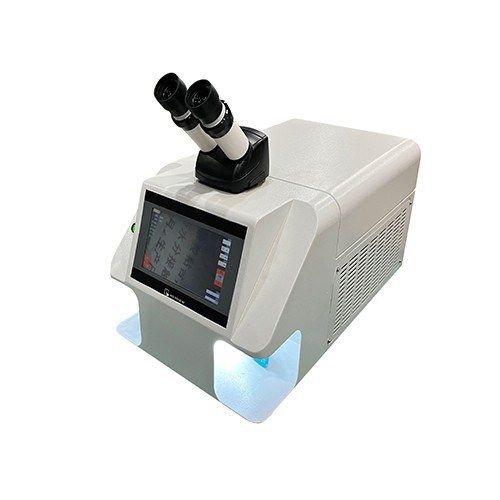
Most permanent jewelry is closed on the wrist with a pulse-arc welder, a unit that can weigh under 1 kg and fires an arc from a tungsten electrode in argon. Published charts start a 24-gauge sterling or 14K jump ring at 3–4 J. A pulsed laser makes the same weld without touching the ring, but it is a Class 4 source, so it suits bench work, with the beam enclosed or everyone nearby wearing laser eyewear.
Key takeaways
- Sunstone's published pulse-arc starting points run from 1.5–3 J for 28-gauge sterling jump rings to 25–30 J for 16-gauge rings. A 24-gauge sterling or 14K gold ring starts at 3–4 J, with argon.
- A pulse-arc welder melts the ring with an arc from a sharpened tungsten electrode to the grounded chain, inside an argon shield. A laser melts it with a focused pulse of invisible 1064–1080 nm light and needs no electrode or ground lead.
- Wear parts differ. Sunstone quotes about 5,000 welds per US$3 tungsten electrode for pulse arc, and a flash-lamp change after 3 million to 5 million or more welds on its Nd:YAG lasers. Both processes use argon.
- Jewelry lasers contain a Class 4 source. OSHA describes Class IV lasers as hazardous to view directly or by diffuse reflection, and notes that a fully enclosed, interlocked high-power laser can be a Class 1 product.
- Sunstone's three permanent jewelry starter kits were listed at US$2,399, US$3,199 and US$4,999 in October 2026. Each includes a pulse-arc welder, a tool kit, 21–45 ft of chain, 50–200 jump rings and 2–4 small argon cylinders.
For closing a chain on a client’s wrist, use a pulse-arc welder. It is small, runs on a tungsten electrode and argon, and Sunstone’s published chart starts a 24-gauge sterling or 14K jump ring at 3–4 J. A pulsed laser welder makes the same weld without touching the ring and lets you set the spot size apart from the energy. It is a Class 4 laser, though, so it fits bench work away from clients: making chain, connectors and repairs.
For bench lasers in depth, see our jewelry laser welder guide.
How do pulse-arc and laser welders compare?
A pulse-arc welder is smaller and cheaper and is made for welds on the body. A laser needs no electrode and sets the spot size separately, but it is a Class 4 hazard.
| Feature | Pulse-arc permanent jewelry welder | Pulsed laser welder (Nd:YAG or QCW fiber) |
|---|---|---|
| How it joins the ring | Arc from a tungsten electrode to the grounded chain, in argon | Focused light pulse melts the seam; 1064 nm (Nd:YAG) or about 1070–1080 nm (fiber) |
| Energy setting | 1–30 J in 1 J steps (Zapp Plus) | Current or peak power, pulse width and frequency |
| Weld spot | About 0.5–2.0 mm (Zapp Plus), tied to the energy setting | Set separately from energy; 0.3–3 mm on the TL Laser 100 |
| Contact with the ring | Electrode tip is brought to the seam; chain must be grounded | None; no ground lead |
| Weld rate | 1 weld per second (Zapp Plus) | 1 Hz and up; a jump ring needs only a few pulses |
| Wear parts | Tungsten electrodes, about 5,000 welds per US$3 electrode | Flash lamp on Nd:YAG (3 million to 5 million+ welds, Sunstone figures) and cooling water; no lamp on QCW fiber |
| Light hazard | Arc light, mostly blue and ultraviolet | Invisible Class 4 beam that welds anything it hits, including skin and eyes |
| Eye protection | Shaded glasses, auto-darkening lens (ADL) or microscope | Chamber and filtered optics, some with an LCD shutter; laser eyewear for any open beam |
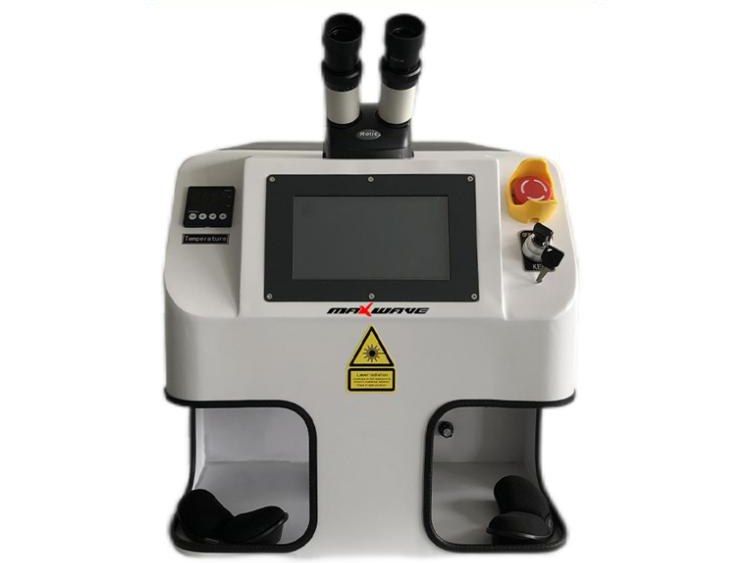
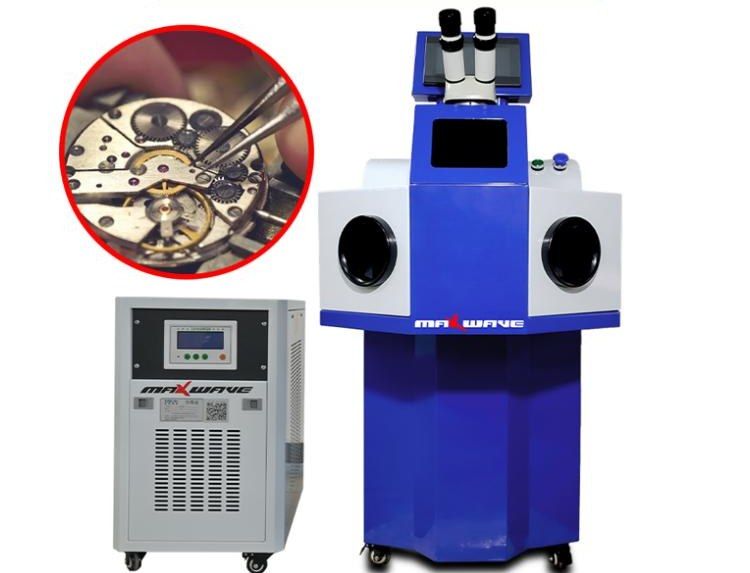
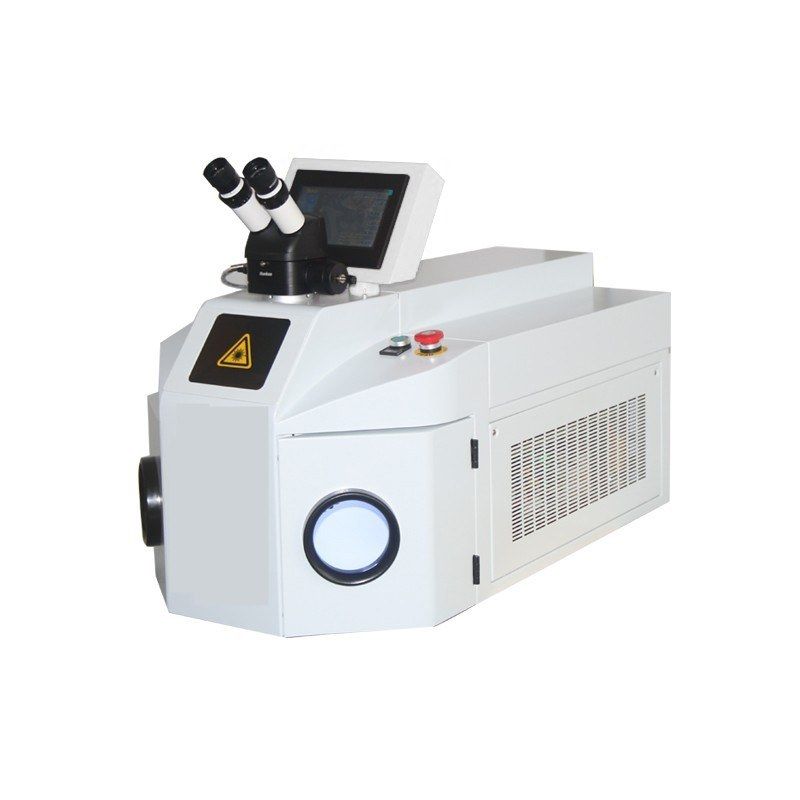
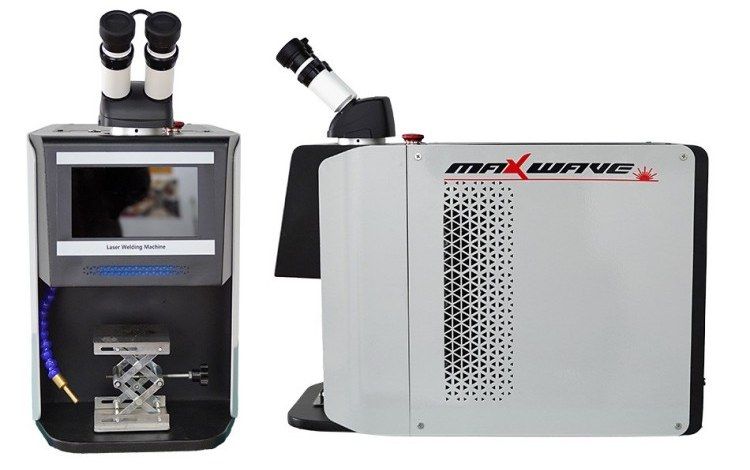
| Size and supply | 0.86 kg, 14.6 × 17 × 9.4 cm, 100/230 V (Zapp Plus) | Maxwave jewelry lasers with published figures: 28–82 kg, 2–7 kW maximum input |
| Listed capital cost | Pulse-arc welders US$2,000–8,000 (Sunstone, 2021); starter kits US$2,399–4,999 (October 2026) | Benchtop lasers US$15,000–25,000 (Sunstone, 2021) |
Maxwave figures are from our product pages.
How does each welder close a jump ring?
A pulse-arc welder melts the open ends with an electric arc. A laser melts them with a focused pulse of light.
Pulse arc
The stylus holds a sharpened tungsten electrode, and the chain is grounded. Argon flows just before the arc fires. It shields the molten metal and helps carry the current. Sunstone describes the weld as taking a few milliseconds and melting both ends of the open link.
- Fit the chain, cut it to length with a little slack, and close the jump ring so the ends touch with no gap.
- Slide a leather patch between the chain and the skin.
- Ground the chain next to the ring with grounded pliers or a clip.
- Touch the electrode to the seam and fire. Pull gently on both sides to check the joint, then clean the weld.
Laser
You place the ring at the crosshair of the microscope or camera, inside the chamber. Each pulse melts a small spot on the seam. Nothing touches the ring and no ground lead is needed. Because the spot size is set apart from the energy, you can aim a small spot at the seam of a fine ring. The limit is practical: the work has to sit under the beam, and the beam is a Class 4 hazard to anyone it can reach.
Which settings should you start with?
Start low and test. Use the values below as starting points only, on scrap of the same metal, gauge and chain, with argon on. Raise the energy in small steps until the ring fuses without a crater or a blown-out end. Sunstone notes that 3 J may over-melt 28-gauge sterling on some welders.
Pulse-arc settings by jump-ring gauge
| Jump ring gauge (wire diameter) | Metal | Starting range | Source |
|---|---|---|---|
| 28 ga (0.32 mm) | Sterling silver | 1.5–3 J | Sunstone chart, 2023 |
| 26 ga (0.41 mm) | 14K yellow gold | 2.5–3 J | Sunstone chart, 2023 |
| 24 ga (0.51 mm) | Sterling; 14K yellow or white gold | 3–4 J | Sunstone chart, 2023 |
| 22 ga (0.64 mm) | 14K yellow gold | 6–8 J | Sunstone chart, 2023 |
| 22 ga (0.64 mm) | Gold-filled | 6–10 J | Sunstone chart, 2023 |
| 21 ga (0.72 mm) | Gold-filled; sterling | 8–12 J | Sunstone chart, 2023 |
| 20 ga (0.81 mm) | Gold-filled; sterling | 11–15 J | Sunstone chart, 2023 |
| 18 ga (1.02 mm) | Gold-filled; 14K yellow; sterling | 20–25 J | Sunstone chart, 2023 |
| 16 ga (1.29 mm) | Gold-filled; 14K yellow; sterling | 25–30 J | Sunstone chart, 2023 |
Each range spans four Sunstone welders (Zapp, Zapp Plus, Orion mPulse, Orion PJ) and assumes argon. The Zapp lists “max power, multiple welds” for 20-gauge and heavier rings, and the Orion PJ for 18-gauge and heavier. Wire diameters use the AWG formula d = 0.127 mm × 92^((36 − gauge) / 39). Other brands may need different values, so check the maker’s own chart.
Laser starting points
We found no published jump-ring chart for jewelry lasers, and pulse-arc joules do not transfer. An arc joule is electrical energy. A laser joule is light, and polished gold and silver reflect much of it. Work from the manual’s start values instead.
| Laser type | Settings you control | Published start point or rule | Source |
|---|---|---|---|
| Lamp-pumped Nd:YAG desktop, current (%) control | Current, frequency, pulse width, spot | 30% current, 1 Hz, 1.0 ms, 1.0 mm spot | TL Laser 100 user guide |
| QCW fiber, peak-power control | Peak power, pulse width, frequency | Pulse energy = peak power × pulse width; 1,200 W × 2 ms = 2.4 J | Formula; peak power from the spec sheet |
From the start point, change one setting at a time. A smaller spot puts the energy on the seam. A longer pulse drives heat deeper. More current or peak power melts more metal. Write down what works for each chain.
Which metals weld best?
Gold-filled, sterling and 14K gold all have published pulse-arc settings. Stainless steel does not, so test it first.
- 14K gold-filled. A layer of 14K gold bonded to a brass core, making up at least 1/20 of the weight (“1/20 14K GF”). Welding without solder melts through the layer, so a little brass mixes into the weld. In one supplier’s six-week wear test, a tiny black dot appeared on the weld. If that matters to a client, use a solid 14K jump ring on gold-filled chain.
- Sterling silver. Silver conducts heat fast and reflects laser light, so a laser needs more energy on it. A laser specialist quoted by Sunstone rates arc welders better for silver, copper and brass, and lasers better for gold and platinum.
- Solid 14K gold. Both processes weld it well. Sunstone lists both 14K yellow and 14K white gold at 3–4 J for 24 gauge.
- Stainless steel. Start at the bottom of the range for that gauge and step up in small increments.
Argon keeps oxygen off the hot metal, and Sunstone’s chart says it gives a stronger and cleaner weld. Some laser welders have a pre-gas setting so argon flows before the first pulse. On a pulse-arc welder the spot size follows the energy setting, so too much energy leaves a larger bead. A laser spot stays the size you set.
What does each welder cost to run?
A pulse-arc welder’s main wear part is the tungsten electrode. A lamp-pumped laser’s is the flash lamp. Both use argon.
- Electrodes (pulse arc). Sunstone quotes about 5,000 welds per US$3 electrode: US$3 ÷ 5,000 = US$0.0006 per weld (2021 figures).
- Argon (both). Sunstone’s kits include 2–4 small Argon Mini cylinders. Refill prices vary by country.
- Flash lamp and cooling (Nd:YAG). Sunstone lists a lamp change after about 3 million welds on its Dado laser (US$275) and after 5 million or more on its benchtop units. The TL Laser 100 has an internal water tank and a shot counter to track lamp life.
- QCW fiber has no flash lamp, and air-cooled versions have no water to change.
- Electricity. The Zapp Plus runs from a 100/230 V adapter. Maxwave’s jewelry lasers list 2–7 kW maximum input, so check the circuit first.
Sunstone’s own comparison warns that a benchtop laser used once or twice a week to close jump rings has a poor return on investment.
How do you keep the client safe?
Protect the client’s skin with a leather patch, and protect everyone’s eyes with gear matched to the process.
Skin
Put a leather patch between the chain and the skin for every weld. Sunstone notes that a weld spot touching the client right after the weld can leave a tiny burn. The patch also guards against a slip of the sharp electrode.
Eyes, for the artist and the client
The arc emits mostly blue and ultraviolet light, and Sunstone warns that repeated exposure can damage the eyes. Never look at the weld unprotected. The artist uses an auto-darkening lens, a filtered microscope or shaded safety glasses. The client wears protective glasses, or looks away and watches on a phone screen.
Laser light at 1064–1080 nm is invisible, and a laser welds anything it hits, including skin and eyes. Inside an enclosed chamber, the housing and filtered optics protect the operator. With any open beam, everyone in the hazard zone needs laser eyewear, which OSHA requires to be labeled with the wavelengths and optical density (OD) it covers. Shaded welding glasses are not laser eyewear.
Laser class and regulations
The manufacturer must classify and label a laser product. In the US, the FDA performance standard (21 CFR 1040.10 and 1040.11) applies to the manufacturer, not the user. Under Laser Notice No. 56, FDA does not intend to enforce the comparable requirements for products that conform to the matching clauses of the international standard IEC 60825-1 Ed. 3.
Jewelry lasers contain a Class 4 source. OSHA describes Class IV lasers as hazardous to view under any condition, directly or diffusely scattered, and as a potential fire and skin hazard. A high-power laser that is fully enclosed, with interlocks and labels, can be a Class 1 product.
On the user side, OSHA’s manual draws on ANSI Z136.1. An unenclosed high-power beam calls for a hazard analysis and a nominal hazard zone (NHZ) assessment by a laser safety officer, and Class IIIB and IV installations require laser safety training. So keep a client’s wrist away from any laser unless the maker’s written instructions cover that use, state the laser class in that setup and list the eyewear needed. See our handheld laser safety guide for more on classes and eyewear.
What comes in a permanent jewelry welder kit?
A pulse-arc kit holds the welder, argon, eye protection, a leather patch, pliers, chain and jump rings.
| Item | Pulse-arc kit | Laser setup at the bench |
|---|---|---|
| Welder | Welder, stylus, ground clip or grounded pliers | Laser welder with chamber or work stand, microscope or camera |
| Electrodes | Tungsten electrodes and a sharpener | None |
| Gas | Argon cylinder, regulator, tubing | Argon cylinder, regulator, nozzle |
| Eye protection | Shaded glasses or ADL for the artist; glasses for the client | Filtered optics; laser eyewear rated for the wavelength if any beam can escape |
| Skin protection | Leather patch | Not needed when the work stays in the chamber |
| Tools and stock | Pliers, chain cutter, tape measure; chain and jump rings in gold-filled, sterling and 14K; practice chain; display case | Same tools and stock |
A Zapp Plus box, for example, holds the welder and stylus, three electrodes, two ground clips, argon tubing and shaded glasses. Sunstone’s starter kits, at listed prices seen in October 2026:
- Momentum, US$2,399: Zapp welder, tool kit, 21 ft of chain, 25 silver and 25 gold-filled jump rings, 2 Argon Mini cylinders, online training.
- Dream, US$3,199: Zapp Plus 2, tool kit and display case, 27 ft of chain with connectors and charms, 50 + 50 jump rings, 2 Argon Mini cylinders, mentoring.
- Legacy, US$4,999: Orion mPulse, tool kit and display case, 45 ft of chain with connectors and charms, 100 + 100 jump rings, 4 Argon Mini cylinders, mentoring.
Tax, duty and freight vary by country, so check what a listed price includes.
What should you check before buying a permanent jewelry welder?
Check the energy range against your gauges first.
- Energy range and steps: about 1.5–3 J for 26–28 gauge and 15–30 J for 20–16 gauge, in steps of 1 J or finer.
- Argon port, with gas timing that starts the flow before the weld.
- Eye protection in the box, for you and the client.
- Weight, input voltage and warranty, plus local service and a steady supply of electrodes.
- For a laser: the class label and classification report, interlocks, filtered optics or a shutter, a spot down to 0.2–0.3 mm, the cooling type, lamp life or a fiber source, and a test weld on your own chain.
How to decide
- If most of your work is closing chain on wrists, ankles and necks, at a counter or at events, buy a pulse-arc welder.
- If you also make chain, connectors and charms, or do repairs in volume, add a pulsed laser at the bench.
- Choose your chain metals and gauges, then check that the welder’s energy range covers them.
- Before the first client, test every metal and gauge on scrap, starting low.
Maxwave builds jewelry laser welders from 60 to 200 W, in Nd:YAG and QCW fiber versions, for chain, jump-ring and repair work at the bench; see laser welding machines, which shows part of the range, with other configurations on request. To check settings on your own chain, use sample testing for a test video and the parameters used.
Sources
- Sunstone (Dave Holloway, 2021): Pulse arc welding vs laser welding, which is better?
- Sunstone (Bryce Bytheway, 2023): The best permanent jewelry weld settings for jump rings
- Sunstone: Zapp Plus permanent jewelry welder data sheet (2023, via H.S. Walsh)
- TL Laser 100 jewellery laser welder user guide (H.S. Walsh)
- Sunstone: Why your permanent jewelry business must have a permanent jewelry welder
- Sunstone: Permanent jewelry starter kits (listed prices and contents, seen October 2026)
- Stones & Findings (Lori French, 2022): Gold filled components and chain
- OSHA Technical Manual, Section III Chapter 6: Laser hazards
- FDA: Laser products, conformance with IEC 60825-1 Ed. 3 and IEC 60601-2-22 Ed. 3.1 (Laser Notice No. 56)